
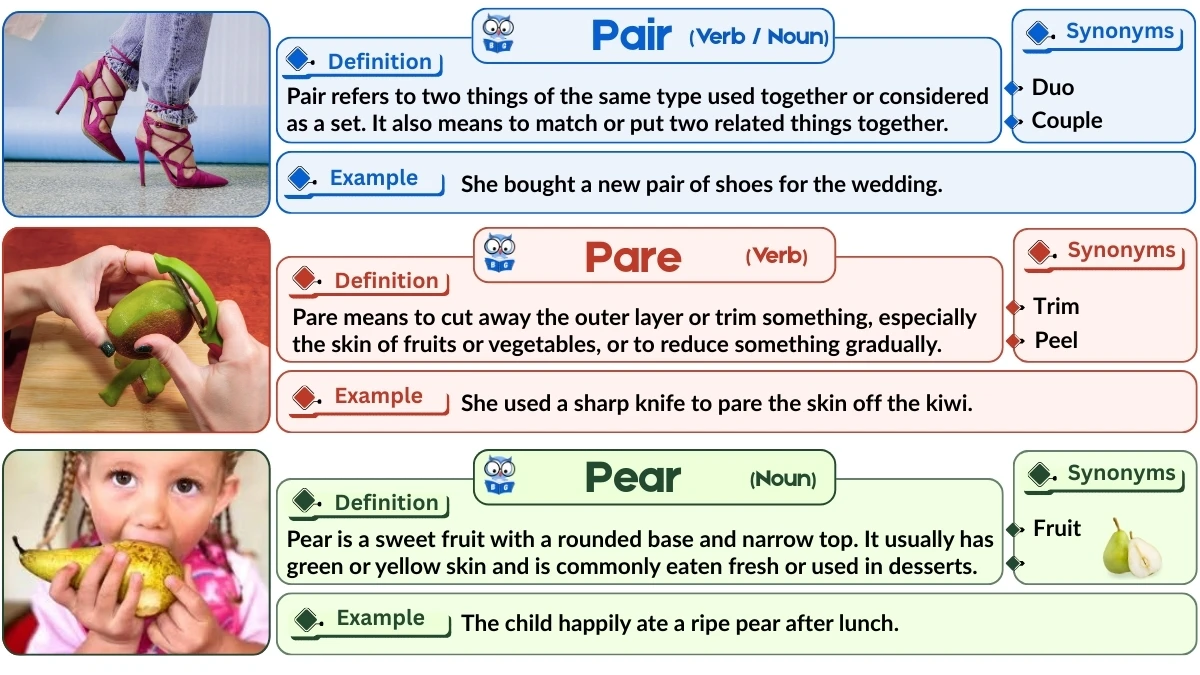
Pair vs. Pare vs. Pear: Difference and Examples
The words pair, pare, and pear sound alike but have completely different meanings. These homophones can easily confuse learners, especially in writing. Each word belongs to a different context—numbers, actions, and food. Let’s understand their meanings clearly with examples.
1. Pair
Meaning & Part of Speech: Noun & Verb — A set of two things used together or regarded as a unit; or to join two things together.
Explanation: "Pair" is a noun and verb that refers to two things that go together or are used together. It is commonly used for items like shoes, socks, or objects that come in sets of two. It can also mean to match or connect two things. This word is widely used in everyday situations.
Example: I bought a new pair of shoes yesterday.
Explanation: In this sentence, pair refers to two shoes that are used together. Shoes always come in sets of two, so the word fits naturally here. It shows how pair is used for things that belong together.
More Examples:
- She wore a pair of earrings.
- I need a pair of scissors.
- The teacher paired the students for the activity.
- They make a perfect pair.
Related Words: Couple, Set, Duo, Match, Twin
2. Pare
Meaning & Part of Speech: Verb — To trim something by cutting away its outer edges, skin, or surface; or to reduce something step by step.
Explanation: "Pare" is a verb that means to cut away the outer layer of something, usually fruits or vegetables. It is often used in cooking and food preparation. The word can also mean to reduce something gradually (e.g., "pare down costs"). It is mostly used in specific or formal contexts.
Example: Please pare the apples before cooking them.
Explanation: In this sentence, pare means to remove the outer skin of the apples. This is usually done to prepare them for cooking. The sentence shows how the word is used in a kitchen or cooking context.
More Examples:
- She pared the potatoes for dinner.
- He carefully pared the orange peel.
- The chef pared the vegetables quickly.
- They tried to pare down their expenses.
Related Words: Peel, Trim, Cut, Reduce, Whittling
3. Pear
Meaning & Part of Speech: Noun — A sweet, juicy, bell-shaped fruit with a green or brownish skin and firm white flesh.
Explanation: "Pear" is a noun that refers to a sweet, juicy fruit. It usually has a rounded bottom and a narrow top. Pears are commonly eaten fresh or used in cooking and desserts. This word is used in everyday conversations about food.
Example: She ate a ripe pear after lunch.
Explanation: In this sentence, pear refers to a type of fruit. It shows something edible and healthy. The word is used in the context of food and eating.
More Examples:
- I like pear juice in the morning.
- The tree is full of ripe pears.
- He bought a basket of pears.
- This pear tastes very sweet.
Related Words: Fruit, Apple, Produce, Snack, Orchard
Common Mistakes to Avoid
-
Writing Pear Instead of Pair for Sets of Two
Incorrect: I need a new pear of socks.
Correct: I need a new pair of socks.
Explanation: A matching set of two items is a pair (spelled with 'ai'), not a fruit (pear). -
Confusing Pare with Pear in Cooking
Incorrect: Please pear the skin off the potatoes.
Correct: Please pare the skin off the potatoes.
Explanation: The action of trimming or peeling the outer skin of produce is pare.
Summary
Although pair, pare, and pear sound the same, their meanings are completely different:
- Pair – Two matching things used together (think of a pair of apples & items).
- Pare – To trim, peel, or reduce the outer layer.
- Pear – A sweet, bell-shaped fruit that you eat (contains 'ea' like eat).
A simple memory tip: You pair and interlock two matching items, you pare away what is non-essential, and you pear is a fruit you eat.
Practice Exercise: Fill in the Blanks Using Pair / Pare / Pear
Choose the correct word (pair, pare, or pear) to complete each sentence:
- I bought a __________ of gloves for winter.
- Please __________ the carrots before cooking.
- She packed a fresh __________ in her lunchbox.
- He needs a __________ of socks for the trip.
- The chef will __________ the vegetables carefully.
- The __________ fell from the tree.