
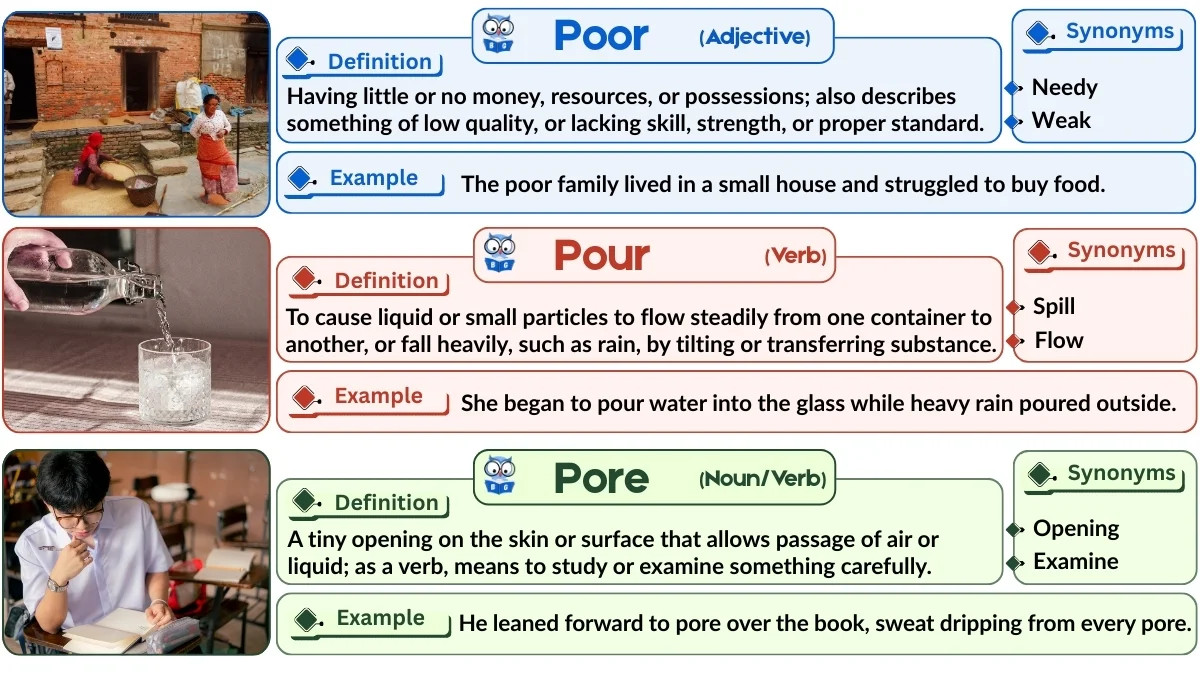
Poor vs. Pour vs. Pore: Difference and Examples
Many English learners confuse poor, pour, and pore because they sound alike but have very different meanings. These words belong to different parts of speech and are used in completely different contexts. Misusing them can change the meaning of a sentence entirely. "Poor" is often related to lack or low quality, while "pour" involves the action of flowing liquid. On the other hand, "pore" refers to tiny openings or deep study. Let’s explore each word in detail to understand their correct usage.
1. Poor
Meaning & Part of Speech: Adjective — Lacking sufficient money, wealth, or resources; of low quality or weak condition; or deserving of pity and sympathy.
Explanation: "Poor" is an adjective used to describe someone who lacks money, resources, or basic necessities. It can also refer to something of low quality or a weak condition. In addition, it is sometimes used to express sympathy for someone. This word is very common in both formal and informal English.
Example: The poor family struggled to afford basic food and shelter.
Explanation: Here, poor describes the family’s financial condition, showing they do not have enough money to meet their needs.
More Examples:
- He gave food to the poor people in the village.
- Her performance was poor in the final exam.
- They lived in poor conditions without electricity.
- I feel sorry for the poor child who lost his parents.
Related Words: Needy, Impoverished, Low-quality, Weak, Unfortunate
2. Pour
Meaning & Part of Speech: Verb — To cause a liquid or other substance to flow in a continuous stream from a container or source.
Explanation: "Pour" is a verb that means to make a liquid flow from one container to another or in a continuous stream. It is often used when talking about drinks, rain, or any flowing substance. The word can also be used figuratively to describe things arriving or flowing in large amounts.
Example: She began to pour tea into the cups for the guests.
Explanation: In this sentence, pour describes the action of transferring tea from a teapot into cups.
More Examples:
- Please pour some water into the glass.
- Rain began to pour heavily in the evening.
- He poured juice for everyone at the table.
- People poured into the stadium to watch the match.
Related Words: Flow, Stream, Spill, Transfer, Discharge
3. Pore
Meaning & Part of Speech: Noun & Verb — A minute opening in a surface (like skin); or to read or study something with steady attention.
Explanation: "Pore" is a noun that refers to tiny openings on the surface of the skin or other materials. It can also be used as a verb meaning to study, examine, or read something very carefully (often with over). The context of the sentence helps determine its meaning.
Example: She spent hours poring over her notes before the exam.
Explanation: Here, pore is used as a verb (in the form "poring"), meaning she studied her notes very carefully and with full attention.
More Examples:
- Sweat comes out through pores in the skin.
- The cream helps to clean your pores.
- He pored over the documents all night.
- Scientists studied the pores of the material closely.
Related Words: Opening, Hole, Hole-surface, Study, Examine, Scrutinize
Common Mistakes to Avoid
-
Writing Pour Instead of Pore for Studying Documents
Incorrect: He was pouring over the legal documents all night.
Correct: He was poring over the legal documents all night.
Explanation: When reading or examining something closely, the correct verb is pore (spelled with an 'e'), not pour (liquid stream). -
Confusing Poor with Pour in Liquid Contexts
Incorrect: Please poor me a glass of water.
Correct: Please pour me a glass of water.
Explanation: Transferring liquid requires the verb pour, whereas poor describes a lack of wealth or quality.
Summary
Although poor, pour, and pore sound identical, their meanings and parts of speech are completely distinct:
- Poor – An adjective meaning needy, impoverished, or low quality (think of double 'oo' as in oout of money).
- Pour – A verb meaning to make liquids flow (contains 'u' like a jug or cup).
- Pore – A noun for tiny skin openings, or a verb meaning to study carefully (ends in 'e' like examine or eyeball).
A simple memory tip: You pour liquid out of a jug, a skin pore helps skin breathe and you pore over books to examine them, while poor describes being out of cash.
Practice Exercise: Fill in the Blanks Using Poor / Pour / Pore
Choose the correct word (poor, pour, or pore) to complete each sentence:
- Please __________ the milk into the glass.
- The __________ man asked for help.
- She spent the night __________ over her books.
- The rain began to __________ suddenly.
- Dirt can block the __________ on your skin.