
Ms. vs. Miss vs. Mrs.: Difference and Examples
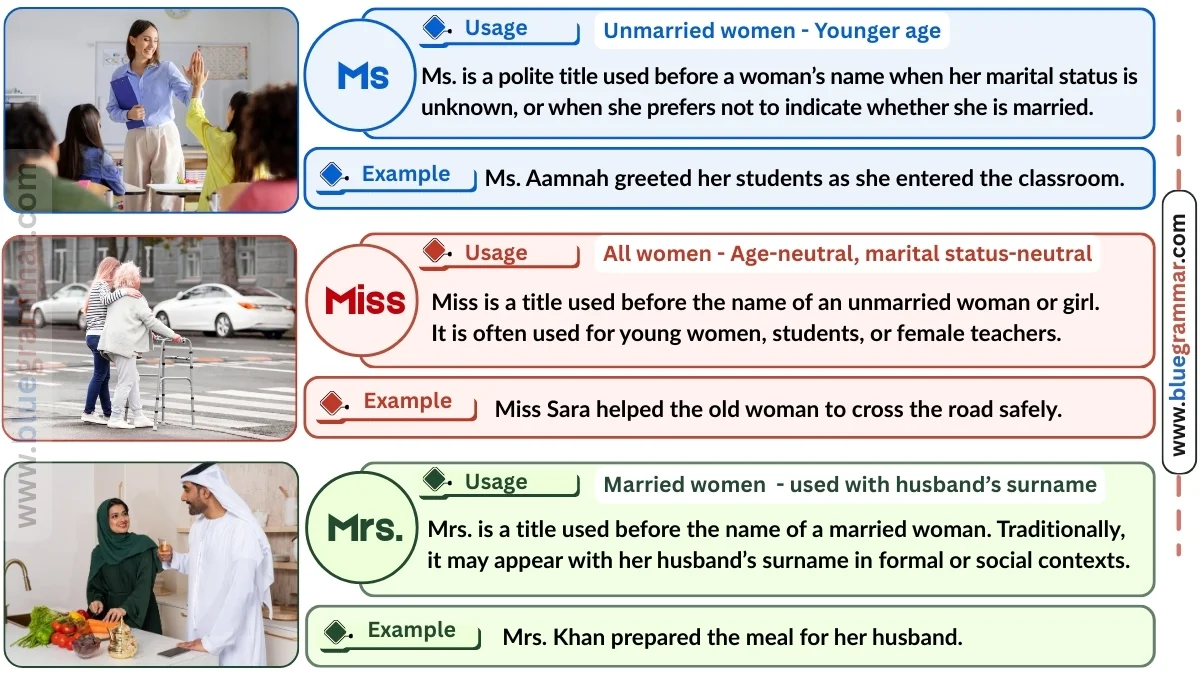
In English, Ms., Miss, and Mrs. are titles used before a woman’s name. They may look similar, but they carry different meanings related to marital status, formality, and context. Understanding the difference helps you address people politely and correctly in both spoken and written communication. This guide explains the subtle differences, correct usage, and examples of Ms., Miss, and Mrs. in clear and simple language.
1. Ms.
Meaning & Part of Speech: Title / Noun — A neutral title used before a woman's surname or full name, regardless of her marital status.
Explanation: Ms. is a neutral title used for a woman without indicating her marital status. It is the most widely accepted and commonly used title in modern English, especially in professional or formal contexts.
When to Use Ms.:
- When you do not know a woman’s marital status
- When marital status is not relevant
- In professional or business communication
- When a woman prefers not to reveal her marital status
Example: Ms. Sarah Khan will lead the meeting today.
Explanation: The title Ms. is used because the speaker either does not know or does not want to specify Sarah’s marital status.
More Examples:
- Please send the report to Ms. Sana by Friday.
- Ms. Taylor is the managing director of the company.
- Dear Ms. Davis, thank you for your application.
Important Note: Many organizations and style guides recommend using Ms. as the default title for women because it avoids unnecessary focus on marital status.
Related Words: Title, Prefix, Address, Professional designation
2. Miss
Meaning & Part of Speech: Title / Noun — A title used before the name of an unmarried woman or girl.
Explanation: Miss is traditionally used for an unmarried woman or girl. It is often used for young women, students, or girls.
When to Use Miss:
- For girls or young unmarried women
- When the woman clearly identifies as unmarried
- In some contexts for teachers addressed by students
Example: Miss Aalia won the school debate competition.
Explanation: The title Miss indicates that Aalia is an unmarried young woman.
More Examples:
- Excuse me, Miss, you dropped your notebook.
- Miss Watson is our primary school art teacher.
- The award for best youth performer went to Miss Emma.
Important Note: In modern professional settings, Miss is used less frequently because it reveals marital status.
Related Words: Maiden, Unmarried woman, Young lady, Title
3. Mrs.
Meaning & Part of Speech: Title / Noun — A title used before the name of a married woman.
Explanation: Mrs. is used for a married woman. Traditionally, it is followed by her husband’s surname, though modern usage may also include her own name.
When to Use Mrs.:
- When referring to a married woman
- When the woman prefers this title
- In formal invitations or traditional contexts
Example: Mrs. Fatima Malik is hosting the event tonight.
Explanation: The title Mrs. indicates that Fatima Malik is married.
More Examples:
- Please welcome Mrs. Javed to the stage.
- Mrs. Smith has been married for over twenty years.
- The invitation was addressed to Mr. and Mrs. Johnson.
Traditional Usage Example: Mrs. John Smith — This older form means the wife of John Smith, though modern usage often prefers using the woman’s own name (e.g., Mrs. Mary Smith).
Related Words: Spouse, Wife, Married title, Prefix
Common Mistakes to Avoid
-
Assuming Marital Status
Incorrect: Miss Amnah will join the meeting.
Correct: Ms. Amnah will join the meeting.
Explanation: If you are unsure about marital status, Ms. is the safest option. -
Using Miss for Older Women in Formal Contexts
Incorrect: Miss Johnson will deliver the presentation.
Correct: Ms. Johnson will deliver the presentation.
Explanation: Ms. sounds more professional and neutral. -
Using Mrs. Without Confirmation
Incorrect: Mrs. Khan will attend the interview.
Correct: Ms. Khan will attend the interview.
Explanation: Use Mrs. only if you know the woman prefers it.
Summary
Although Ms., Miss, and Mrs. are all titles used for women, they differ mainly in how they relate to marital status:
- Ms. – Neutral title; marital status not specified.
- Miss – Used for unmarried women or girls.
- Mrs. – Used for married women.
A simple way to remember the difference is that Ms. is for safe/standard professional use when status is unknown, Miss is for an unmarried miss (single girl), and Mrs. includes the ring of marriage.
Practice Exercise: Fill in the Blanks Using Ms. / Miss / Mrs.
Choose the correct word (Ms., Miss, or Mrs.) to complete each sentence:
- __________ Khan is my class teacher.
- __________ Sara is not married yet.
- __________ Ahmed is a married woman.
- We invited __________ Ali to the meeting, but we don’t know her marital status.
- __________ Fatima lives next door with her husband.
- The letter was addressed to __________ Sana (marital status unknown).