
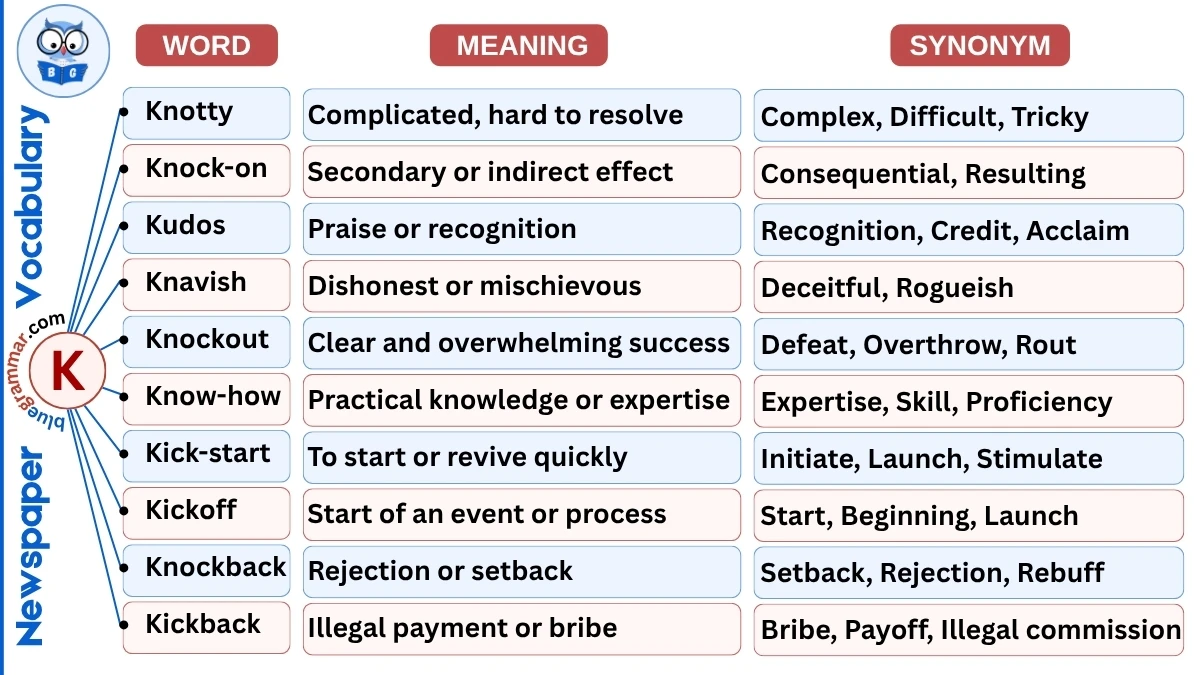
Newspaper Vocabulary | Words Starting with K
Welcome to our comprehensive guide on newspaper vocabulary starting with the letter K. Mastering these formal, precise, and analytical terms will greatly enhance your reading comprehension of news articles, opinion pieces, and editorial columns, as well as elevate your written English.
1. Keel
Part of Speech: Noun, Verb
Meaning: To recover from a tilt or imbalance.
Explanation: Metaphorically, this word is used in political, social, and economic contexts to indicate stability or recovery. It often describes how a system or situation returns to balance after disruption.
Example: The economy is back on keel after recent reforms.
2. Knotty
Part of Speech: Adjective
Meaning: Complicated or difficult.
Explanation: This word describes issues, problems, or situations that are complex and hard to resolve. It is often used in political negotiations, legal debates, and international relations.
Example: The negotiation involved several knotty issues that required careful attention.
3. Keen
Part of Speech: Adjective
Meaning: Eager or enthusiastic.
Explanation: This word is used to show strong interest or attention, especially in politics, business, or social causes. It highlights an active and engaged attitude.
Example: The minister showed keen interest in education reforms and participated actively in the discussions.
4. Keynote
Part of Speech: Noun, Adjective
Meaning: Main speech or central idea.
Explanation: Commonly used in politics and corporate events, a keynote represents the central message of a gathering. It can also be the theme around which discussions revolve.
Example: The president delivered the keynote address at the economic summit, highlighting future development plans.
5. Kindle
Part of Speech: Verb
Meaning: To start or ignite.
Explanation: Used metaphorically in news, this word often refers to initiating hope, debate, or conflict. It emphasizes the spark that triggers a larger reaction or movement.
Example: The government’s announcement kindled public debate on climate policy.
6. Knock-on
Part of Speech: Adjective, Noun
Meaning: Secondary or indirect effect.
Explanation: This phrase is used to describe consequences that occur as a result of a prior event. It is common in economic, political, and social reporting.
Example: The policy change had a knock-on effect on local businesses and employment.
7. Kinetic
Part of Speech: Adjective
Meaning: Relating to motion or energy.
Explanation: Often used in military, scientific, or technological reporting, this word describes physical energy or movement. It can also be metaphorical, describing dynamic activity or momentum.
Example: Kinetic forces were observed during the controlled demolition of the building.
8. Kudos
Part of Speech: Noun
Meaning: Praise or recognition.
Explanation: This word is used to highlight achievement or success. It often appears in human-interest stories, corporate reporting, or awards coverage.
Example: The scientist received kudos for her groundbreaking research in renewable energy.
9. Kernel
Part of Speech: Noun
Meaning: Core or essence.
Explanation: Kernel refers to the most important or central part of an idea, argument, or story. It is often used in analytical and editorial reporting.
Example: The kernel of the argument lies in balancing economic growth with environmental sustainability.
10. Knavish
Part of Speech: Adjective
Meaning: Dishonest or mischievous.
Explanation: This word is commonly used in investigative reporting to describe unethical behavior or schemes. It highlights deception or trickery.
Example: The scheme was executed in a knavish manner, misleading investors and regulators.
11. Knockout
Part of Speech: Noun, Adjective
Meaning: Decisive victory.
Explanation: Used in sports, politics, and competitions, this word describes a clear and overwhelming success. It emphasizes the finality or impact of a win.
Example: The team achieved a knockout victory in the finals, leaving their rivals far behind.
12. Know-how
Part of Speech: Noun
Meaning: Practical knowledge or expertise.
Explanation: This word highlights skills and competence in performing tasks or handling situations. It is commonly used in business, technological, and policy reporting.
Example: The company’s know-how enabled it to innovate rapidly and stay ahead of competitors.
13. Keep
Part of Speech: Verb, Noun
Meaning: To maintain or preserve.
Explanation: Keep is often used in administrative, organizational, or record-keeping contexts. It indicates sustaining accuracy or continuity.
Example: Officials must keep detailed records to ensure transparency and accountability.
14. Kick-start
Part of Speech: Verb, Noun
Meaning: To start or revive quickly.
Explanation: This word is commonly used in economic, developmental, and project-related news. It refers to giving an initiative a strong beginning or boost.
Example: The government’s new program aims to kick-start small businesses across the region.
15. Key
Part of Speech: Adjective, Noun
Meaning: Crucial or important.
Explanation: Used to identify something central or decisive in politics, business, or social affairs. It emphasizes significance and influence.
Example: Education is a key priority in the government’s development agenda.
16. Kingdom
Part of Speech: Noun
Meaning: Country ruled by a monarch.
Explanation: Frequently used in geopolitical reporting, kingdom refers to a nation or territory under monarchy. It is also used metaphorically to indicate influence or control.
Example: The kingdom announced sweeping reforms in healthcare and education.
17. Knowledge
Part of Speech: Noun
Meaning: Awareness or understanding.
Explanation: Knowledge is critical in journalism, policy, and educational reporting. It emphasizes being informed and making decisions based on information.
Example: Knowledge of global economic trends is vital for policymakers and investors.
18. Key player
Part of Speech: Noun Phrase
Meaning: Important participant.
Explanation: This phrase is used to describe individuals or entities with significant influence in politics, business, or events.
Example: He emerged as a key player in the international trade negotiations.
19. Kickoff
Part of Speech: Noun
Meaning: Start of an event or process.
Explanation: Kickoff describes the beginning of a campaign, project, or event. It is commonly used in political, social, and sports reporting.
Example: The campaign kickoff attracted thousands of enthusiastic supporters.
20. Knockback
Part of Speech: Noun
Meaning: Rejection or setback.
Explanation: This word highlights failure, opposition, or denial in political, business, or social contexts. It emphasizes unexpected obstacles.
Example: The proposal faced a knockback from parliament, delaying its implementation.
21. Kith
Part of Speech: Noun
Meaning: Friends or social circle.
Explanation: Often used in human-interest stories, kith refers to acquaintances, relatives, or close connections. It highlights social bonds or influence.
Example: The decision pleased his kith and kin, strengthening local support.
22. Keystone
Part of Speech: Noun
Meaning: Central or essential element.
Explanation: Used metaphorically in political, economic, or social reporting, keystone highlights what holds a system, plan, or structure together.
Example: Cooperation is the keystone of the peace agreement.
23. Kinship
Part of Speech: Noun
Meaning: Connection or relationship.
Explanation: Kinship is used in human-interest, cultural, and social reporting. It refers to bonds of family, friendship, or shared identity.
Example: Kinship ties influenced the local political landscape.
24. Kickback
Part of Speech: Noun
Meaning: Illegal payment or bribe.
Explanation: Kickback is widely used in investigative reporting to describe corruption. It often refers to secret payments for favors or contracts.
Example: Officials were accused of accepting kickbacks during the procurement process.
25. Knowledgeable
Part of Speech: Adjective
Meaning: Well-informed or expert.
Explanation: This word is used to describe people with understanding or expertise in politics, business, or science. It is often applied to analysts or commentators.
Example: The panelists were knowledgeable about global trade policies and market trends.