
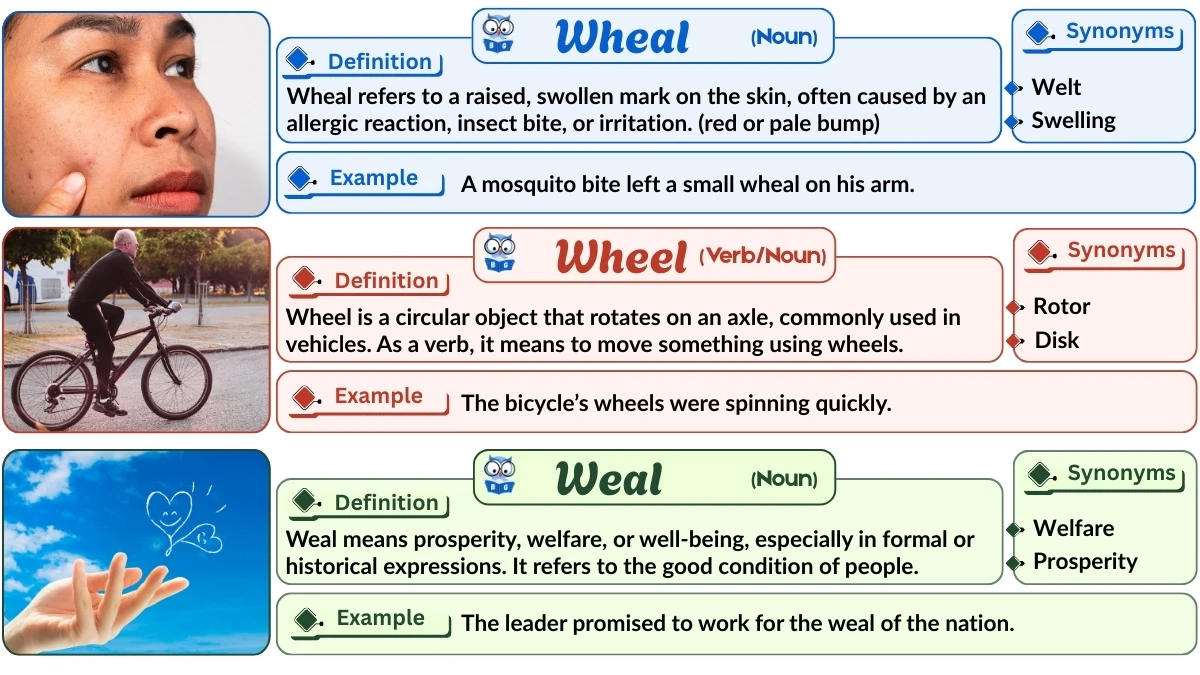
Wheal vs. Wheel vs. Weal: Difference and Examples
English learners often confuse wheal, wheel, and weal because they sound identical but have completely different meanings. These homophones belong to distinct contexts, ranging from medicine and machinery to literature and economics. A small spelling error can change the entire meaning of your sentence. "Wheal" refers to a raised welt or mark on the skin, "wheel" refers to a circular object that rotates, and "weal" relates to prosperity, well-being, or fortune. Let’s explore each word in detail to understand their correct usage.
1. Wheal
Meaning & Part of Speech: Noun — A suddenly formed, raised, and often itchy mark or welt on the skin, typically caused by an allergic reaction or insect bite.
Explanation: "Wheal" is a noun commonly used in medical and dermatological contexts. It refers to a swollen, red, or pale ridge on the skin that usually accompanies itching, such as hives or a mosquito bite reaction. In mining history, it can also refer to a tin or copper mine (often spelled wheal in Cornish names), but its primary modern usage is medical.
Example: An itchy wheal appeared on her arm after the mosquito bit her.
Explanation: In this sentence, wheal refers to the raised, swollen welt formed on the skin as a reaction to a mosquito bite.
More Examples:
- The allergic reaction caused several red wheals to break out on his back.
- The doctor observed a raised wheal around the skin test site.
- Antihistamines can help reduce the swelling of a hive or wheal.
- The skin allergy presented as small, circular wheals.
Related Words: Welt, Hive, Swelling, Bump, Ridge, Blister
2. Wheel
Meaning & Part of Speech: Noun & Verb — A circular frame or solid disc that revolves on an axle; or to push, guide, or revolve on wheels.
Explanation: "Wheel" is a noun and verb used extensively in everyday language, engineering, transportation, and mechanics. As a noun, it describes the circular component that allows vehicles and machines to move smoothly. As a verb, it means to push or roll something on wheels or to turn around abruptly.
Example: The bicycle's front wheel went flat during the journey.
Explanation: Here, wheel refers to the circular rotating mechanism of the bicycle that enables movement.
More Examples:
- She turned the steering wheel to avoid the pothole.
- The potter placed the clay onto the spinning wheel.
- He wheeled the heavy cart into the storage room.
- The car has four sturdy wheels designed for off-road driving.
Related Words: Disc, Ring, Roller, Axle, Rotate, Turn
3. Weal
Meaning & Part of Speech: Noun — Sound, healthy, or prosperous state; well-being, welfare, or fortune; also an alternate spelling for a welt (ridge on skin).
Explanation: "Weal" is a noun most commonly found in political, formal, economic, or literary phrases such as "the public weal" or "in weal and woe" (in good times and bad times). It refers to general welfare, happiness, or prosperity. Historically and occasionally in older texts, it can also refer to a welt or ridge on the skin, but in modern English, "well-being/prosperity" is its primary distinction.
Example: Leaders should always make decisions for the public weal.
Explanation: In this sentence, weal means the overall well-being, benefit, and prosperity of the general public.
More Examples:
- They promised to stay together in weal and woe.
- The laws were created to protect the common weal.
- Economic stability contributes greatly to the national weal.
- He prioritized the weal of his community above his own interests.
Related Words: Well-being, Welfare, Prosperity, Happiness, Fortune
Common Mistakes to Avoid
-
Writing Weal or Wheal Instead of Wheel for Vehicles
Incorrect: He changed the flat weal on his car.
Correct: He changed the flat wheel on his car.
Explanation: Circular rotating machinery and vehicle parts always use wheel (spelled with double 'e'). -
Confusing Wheel with Weal in Formal Welfare Phrases
Incorrect: Politicians must work for the public wheel.
Correct: Politicians must work for the public weal.
Explanation: The phrase meaning public well-being or welfare is weal (spelled without 'h').
Summary
Although wheal, wheel, and weal sound identical, their origins and meanings are very different:
- Wheal – A raised, itchy skin welt from an allergy or bite (starts with 'wh' and contains 'ea').
- Wheel – A circular rotating object for transportation or machinery (contains double 'ee' like speed).
- Weal – Prosperity, welfare, or good fortune (starts with a single 'w' like welfare and well-being).
A simple memory tip: A wheal is an itchy skin reaction from a whip or bug, a wheel rolls on teeth/axles, and weal stands for national welfare and wealth!
Practice Exercise: Fill in the Blanks Using Wheal / Wheel / Weal
Choose the correct word (wheal, wheel, or weal) to complete each sentence:
- The driver grabbed the steering __________ with both hands.
- True statesmen work for the public __________ rather than personal profit.
- After being stung by a bee, an itchy red __________ formed on his leg.
- They vowed to support each other through __________ and woe.
- The front __________ of the luggage bag broke during transit.