
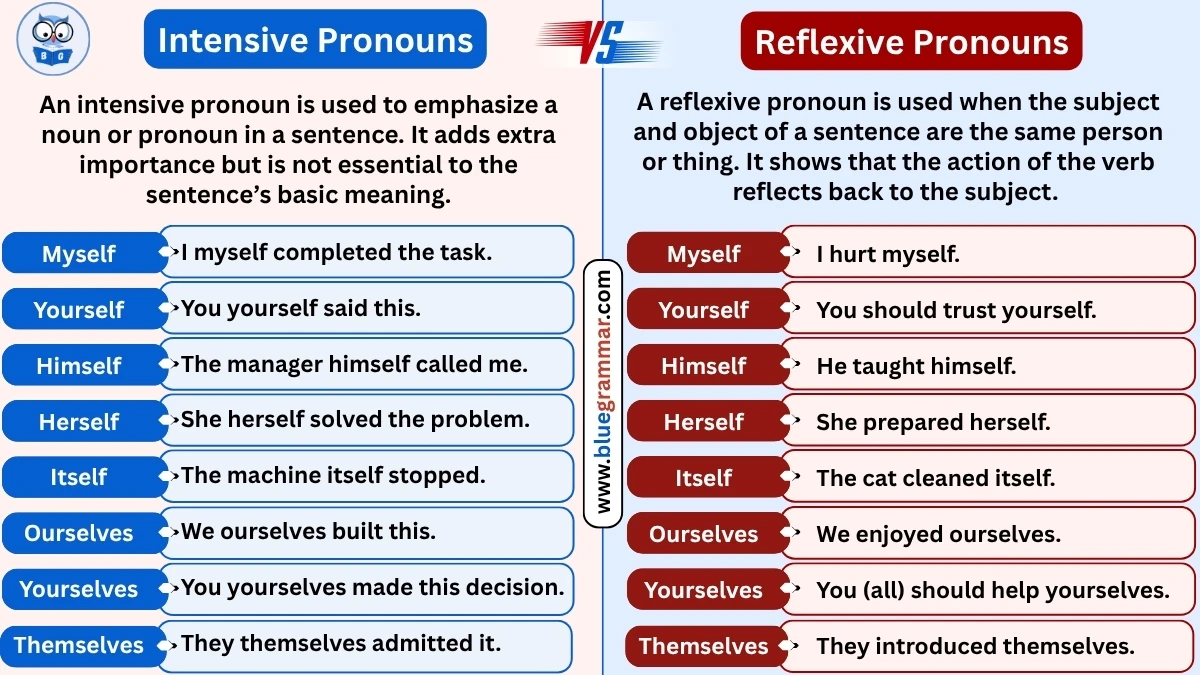
Understanding the difference between intensive pronouns and reflexive pronouns is important because they look the same but function differently in sentences. Both use words ending in -self or -selves, but their purpose changes the meaning of the sentence.
Intensive Pronouns
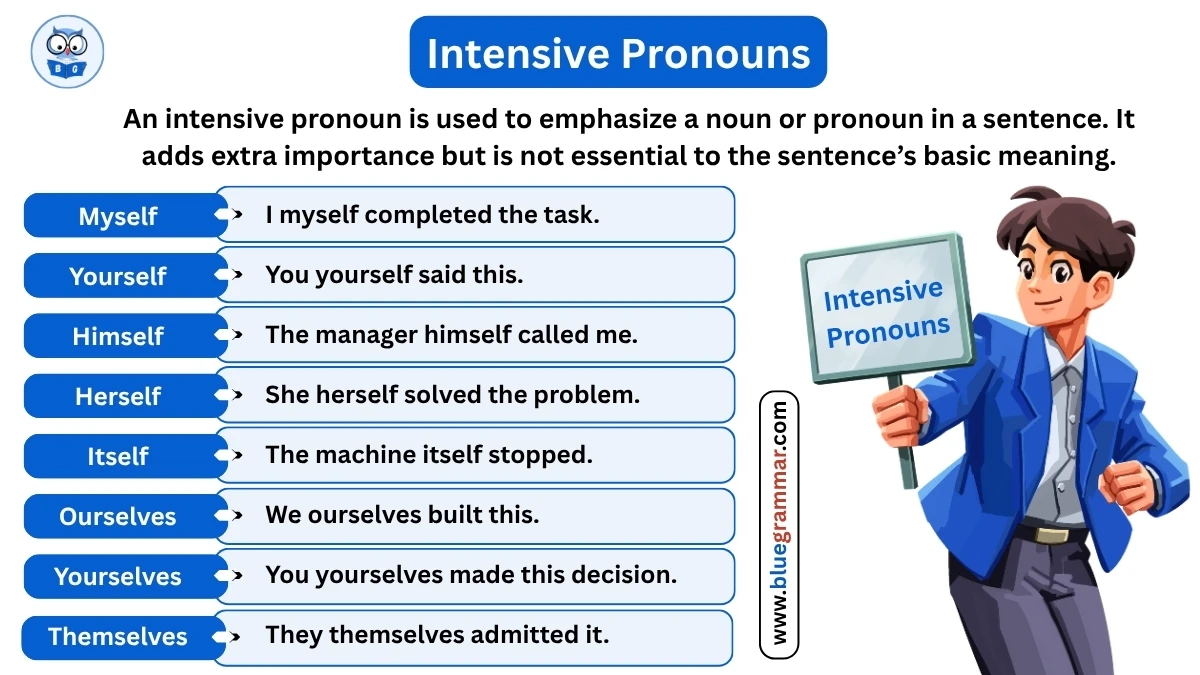
An intensive pronoun is used to emphasize a noun or pronoun in a sentence. It adds extra importance but is not essential to the sentence’s basic meaning. If you remove the intensive pronoun, the sentence will still be grammatically correct and keep its main idea. Intensive pronouns usually come right after the noun they emphasize or at the end of the sentence. For example, in “I myself completed the work,” the word “myself” emphasizes that I did the work personally. These pronouns are used for focus and emphasis, not for showing action.
Common Intensive Pronouns
- Myself
- Yourself
- Himself
- Herself
- Itself
- Ourselves
- Yourselves
- Themselves
Intensive Pronouns Examples (With Explanation)
- I myself finished the project. (Emphasizes that I did it personally)
- She wrote the report herself. (Adds emphasis to she)
- The CEO himself attended the meeting. (Highlights importance of the CEO)
- We completed the task ourselves. (Emphasizes we, not someone else)
- The machine itself stopped working. (Emphasizes the machine)
Reflexive Pronouns
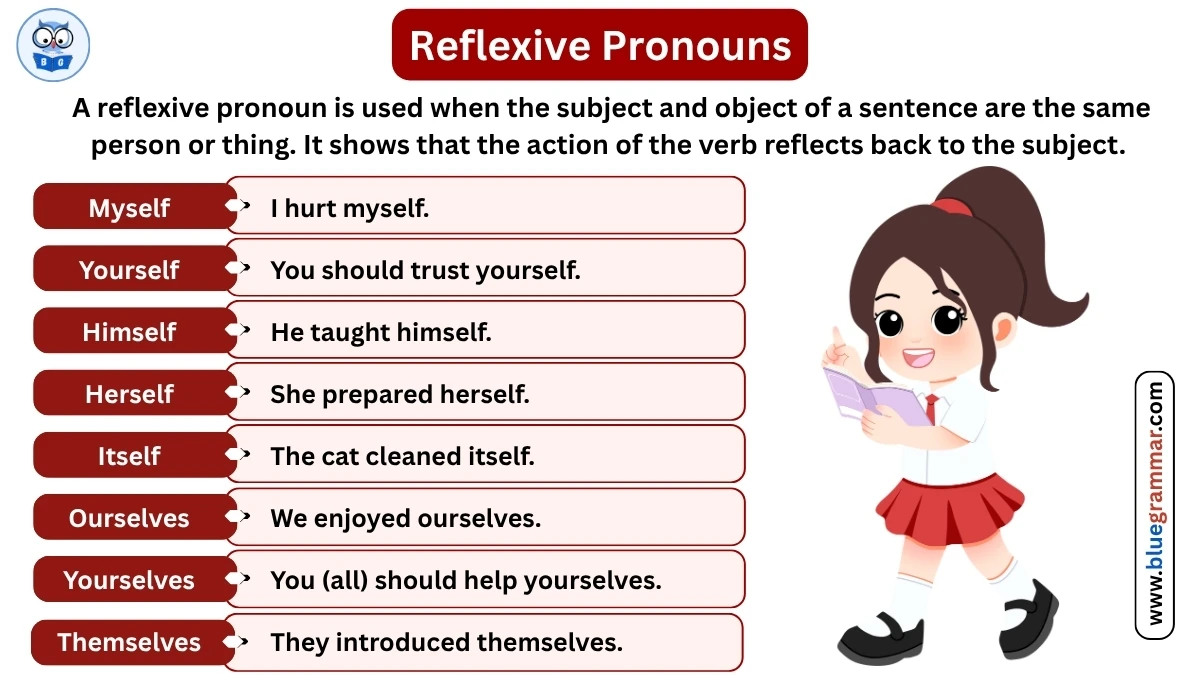
A reflexive pronoun is used when the subject and object of a sentence are the same person or thing. It shows that the action of the verb reflects back to the subject. Reflexive pronouns are essential to the meaning of the sentence; removing them often makes the sentence incomplete or changes its meaning. For example, in “She hurt herself,” the word “herself” shows that she is both the doer and receiver of the action. Reflexive pronouns are commonly used with verbs like hurt, teach, enjoy, prepare, and introduce.
Common Reflexive Pronouns
- Myself
- Yourself
- Himself
- Herself
- Itself
- Ourselves
- Yourselves
- Themselves
Reflexive Pronouns Examples (With Explanation)
- I hurt myself. (The action returns to the subject)
- She prepared herself for the exam. (She is both doer and receiver)
- They enjoyed themselves at the party. (The enjoyment applies to them)
- He taught himself English. (He learned on his own)
- We introduced ourselves. (We did the action to ourselves)
Common Mistakes and Confusions
1. Using reflexive pronoun unnecessarily
Incorrect: Myself will do it
Correct: I will do it
2. Confusing emphasis with action
Incorrect: I myself hurt
Correct: I hurt myself
3. Wrong placement
Incorrect: Myself I completed the work
Correct: I myself completed the work
4. Using object pronoun instead of reflexive
Incorrect: He hurt him
Correct: He hurt himself
5. Overuse of intensive pronouns
Incorrect: I myself personally think…
Correct: I think… / I myself think…
Summary
Intensive pronouns and reflexive pronouns may look identical, but they serve different purposes in a sentence. Intensive pronouns are used for emphasis and can be removed without affecting the core meaning, as in “I myself completed the work.” In contrast, reflexive pronouns are necessary when the subject performs an action on itself, as in “I hurt myself.” The key difference lies in their function: intensive pronouns add emphasis, while reflexive pronouns show that the action returns to the subject. Understanding this distinction helps avoid confusion and ensures more accurate and effective communication in English.