
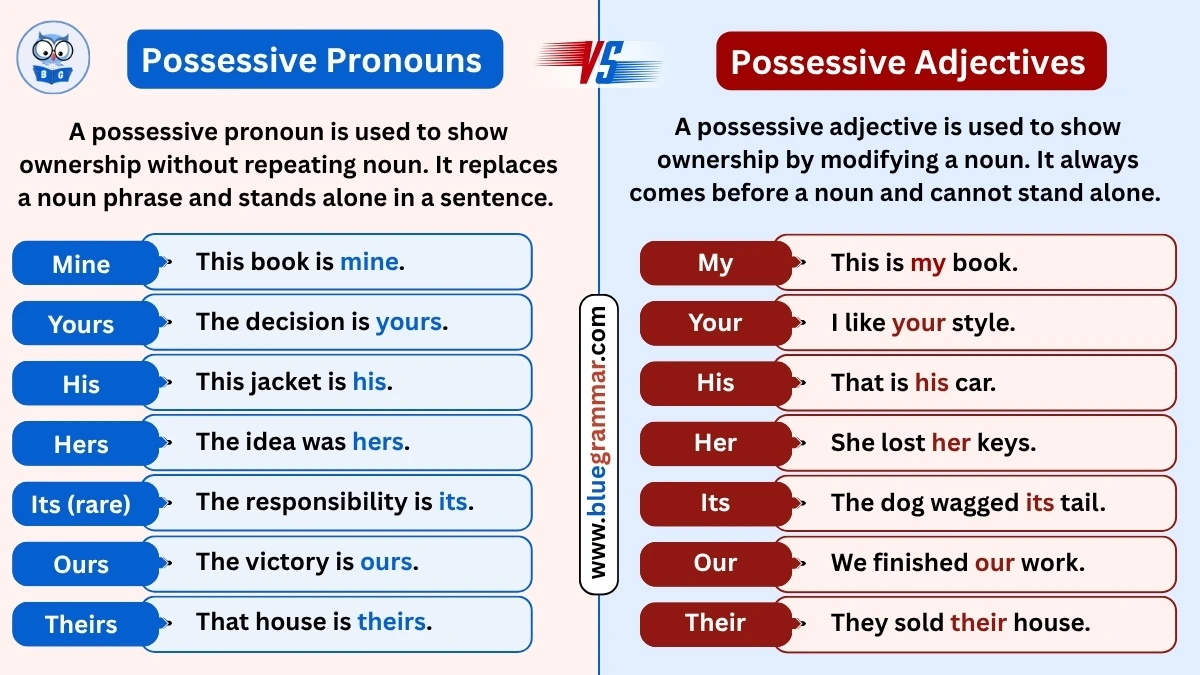
Understanding the difference between possessive pronouns and possessive adjectives is essential for correct sentence structure. Both show ownership or possession, but they are used differently in sentences.
Possessive Pronouns
A possessive pronoun is used to show ownership without repeating the noun. It replaces a noun phrase and stands alone in a sentence. This makes sentences shorter, clearer, and less repetitive. Possessive pronouns are especially useful when the noun is already understood from context. For example, instead of saying “This is my book,” you can say “This book is mine.” Here, “mine” replaces “my book.” Unlike possessive adjectives, possessive pronouns are not followed by a noun; they function independently as the subject or object of a sentence.
Common Possessive Pronouns
- Mine
- Yours
- His
- Hers
- Its (rarely used)
- Ours
- Theirs
Possessive Pronouns Examples (With Explanation)
- This book is mine. (“Mine” replaces my book)
- That house is theirs. (“Theirs” replaces their house)
- The choice is yours. (“Yours” replaces your choice)
- This idea is hers. (“Hers” replaces her idea)
- The responsibility is ours. (“Ours” replaces our responsibility)
Possessive Adjectives
A possessive adjective is used to show ownership by modifying a noun. It always comes before a noun and cannot stand alone. Possessive adjectives help identify who owns something by directly describing the noun. For example, in “This is my book,” the word “my” describes the noun book and tells us who owns it. Unlike possessive pronouns, possessive adjectives must be followed by a noun, which makes them an essential part of noun phrases.
Common Possessive Adjectives
- My
- Your
- His
- Her
- Its
- Our
- Their
Possessive Adjectives Examples (With Explanation)
- This is my book. (“My” describes the noun book)
- That is their house. (“Their” describes house)
- I like your idea. (“Your” describes idea)
- She lost her keys. (“Her” describes keys)
- We finished our work. (“Our” describes work)
Common Mistakes and Confusions
1. Using possessive adjective without a noun
Incorrect: This book is my
Correct: This book is mine
2. Using possessive pronoun before a noun
Incorrect: This is mine book
Correct: This is my book
3. Confusing “its” and “it’s”
Incorrect: The dog wagged it’s tail
Correct: The dog wagged its tail
“It’s” = it is, while “its” shows possession.
4. Mixing forms incorrectly
Incorrect: This is her book, it is her
Correct: This is her book, it is hers
5. Overusing nouns (repetition)
Incorrect: This is my book and that is your book
Correct: This is my book and that is yours
Summary
Possessive pronouns and possessive adjectives both express ownership, but they differ in structure and usage. Possessive pronouns (mine, yours, his, hers, ours, theirs) replace nouns and stand alone, making sentences less repetitive and more concise. In contrast, possessive adjectives (my, your, his, her, its, our, their) always come before a noun and describe it by indicating ownership. The key difference lies in their position: if the word is followed by a noun, it is a possessive adjective; if it stands alone, it is a possessive pronoun. Mastering this distinction helps improve sentence clarity and grammatical accuracy, especially in both writing and speaking.