
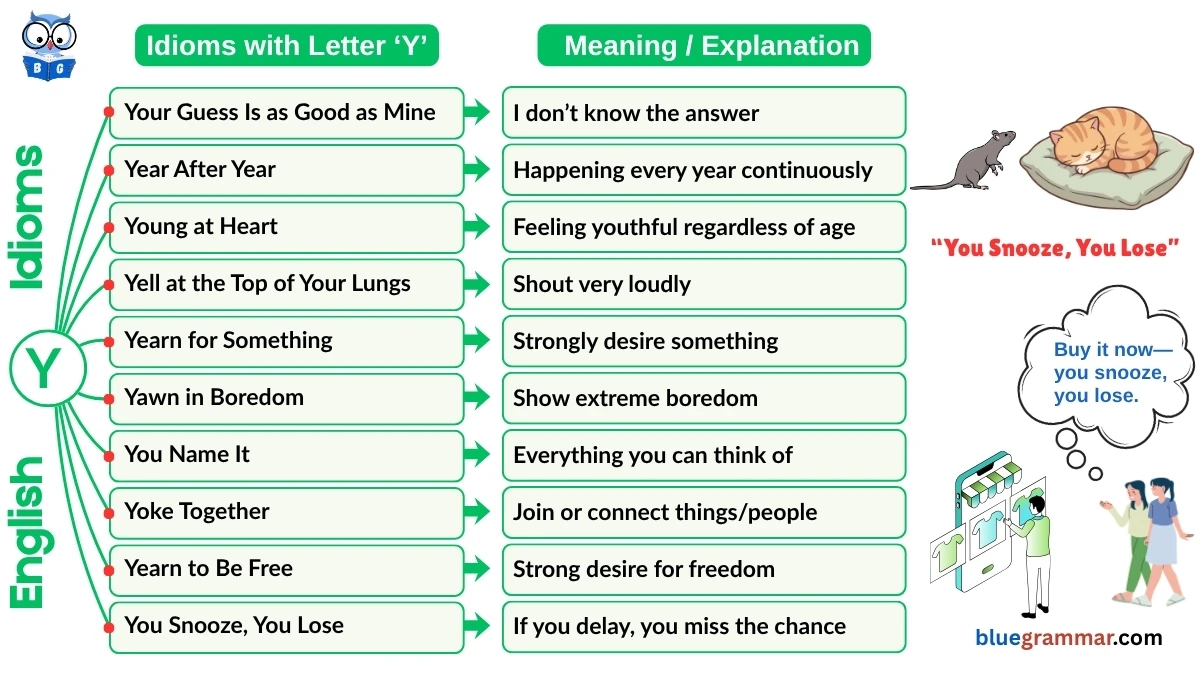
English Idioms Starting with the Letter Y
1. You Snooze, You Lose
Meaning: If you delay, you miss the chance
Explanation: This phrase means that hesitation or laziness can cause you to lose opportunities. It encourages quick action and alertness. It is often used in competitive situations.
Examples:
- Buy it now— you snooze, you lose.
- He missed the deal because you snooze, you lose.
2. Your Guess Is as Good as Mine
Meaning: I don’t know the answer
Explanation: This idiom is used when someone has no idea about something and cannot provide an answer. It is a polite way of admitting uncertainty. It is commonly used in informal conversations when both people are unsure.
Examples:
- Where is he? Your guess is as good as mine.
- What will happen next? Your guess is as good as mine.
3. Year After Year
Meaning: Happening every year continuously
Explanation: This phrase is used when something repeats regularly every year without stopping. It often describes traditions, events, or habits. It shows consistency over time.
Examples:
- They visit the village year after year.
- Year after year, he wins the award.
4. Young at Heart
Meaning: Feeling youthful regardless of age
Explanation: This idiom is used for people who feel energetic, happy, and active even if they are old in age. It describes a positive and lively personality. It is often used to appreciate spirit rather than age.
Examples:
- My grandfather is young at heart.
- She is 70 but still young at heart.
5. You Can’t Judge a Book by Its Cover
Meaning: Don’t judge based on appearance
Explanation: This phrase means that you should not form an opinion about someone or something only by how it looks. True value or character is often hidden inside. It teaches fairness and deeper understanding.
Examples:
- He looks strict, but you can’t judge a book by its cover.
- Remember, you can’t judge a book by its cover.
6. Yell at the Top of Your Lungs
Meaning: Shout very loudly
Explanation: This idiom is used when someone screams or shouts with full force. It suggests strong emotion like anger, fear, or excitement. It is often used in dramatic situations.
Examples:
- She yelled at the top of her lungs.
- He was yelling at the top of his lungs for help.
7. Yearn for Something
Meaning: Strongly desire something
Explanation: This phrase is used when someone deeply wants or misses something. It often expresses emotional longing. It is commonly used for dreams, love, or memories.
Examples:
- She yearns for success.
- He yearns for his hometown.
8. Yield to Pressure
Meaning: Give in to pressure or influence
Explanation: The idiom yield to pressure is used when someone agrees to something after being pressured. It often suggests loss of resistance or decision under influence. It can be used in social or professional situations.
Examples:
- He yielded to pressure and agreed.
- Don’t yield to pressure easily.
9. Yawn in Boredom
Meaning: Show extreme boredom
Explanation: This phrase is used when someone is so bored that they cannot stay interested. Yawning is a natural sign of tiredness or lack of interest. It is often used in dull situations or events.
Examples:
- The lecture made everyone yawn in boredom.
- He was yawning in boredom during the meeting.
10. You Name It
Meaning: Everything you can think of
Explanation: This idiom is used when referring to a wide range of things without listing them all. It suggests variety and completeness. It is commonly used in casual speech.
Examples:
- They sell fruits, vegetables, snacks—you name it.
- We discussed sports, politics, travel—you name it.
11. Yoke Together
Meaning: Join or connect things/people
Explanation: This phrase is used when two or more things or people are linked or combined. It often suggests cooperation or forced connection. It is used in both literal and figurative meanings.
Examples:
- The project yokes together different skills.
- They were yoked together by circumstances.
12. Yearn to Be Free
Meaning: Strong desire for freedom
Explanation: This idiom is used when someone deeply wants independence or freedom from restrictions. It often expresses emotional or physical longing. It is commonly used in personal or social contexts.
Examples:
- The bird yearns to be free.
- He yearns to be free from stress.