
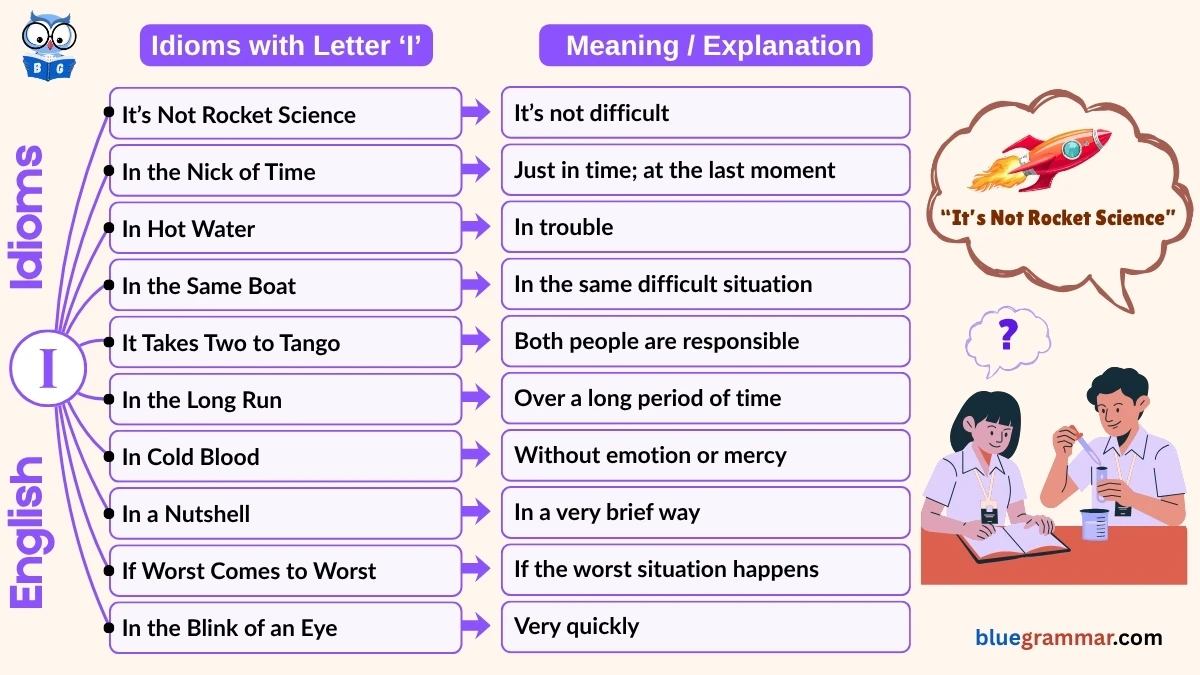
English Idioms Starting with the Letter I
1. It’s Not Rocket Science
Meaning: It’s not difficult
Explanation: This idiom is used to say that something is easy to understand or do. It often implies that others should not find it complicated. It is commonly used in informal conversations.
Examples:
- Come on, it’s not rocket science.
- This task is simple—it’s not rocket science.
2. In the Nick of Time
Meaning: Just in time; at the last moment
Explanation: This idiom is used when something happens exactly at the right moment, just before it is too late. It often involves a sense of relief because a problem or danger was avoided. Timing is very important in this expression.
Examples:
- He arrived in the nick of time to catch the train.
- The doctor came in the nick of time.
3. In Hot Water
Meaning: In trouble
Explanation: This phrase is used when someone is facing difficulties or is likely to be punished for something they did wrong. It often involves authority figures like teachers, parents, or bosses. It highlights a stressful situation.
Examples:
- He got into hot water for breaking the rules.
- She is in hot water with her manager.
4. In the Same Boat
Meaning: In the same difficult situation
Explanation: This idiom is used when two or more people are facing the same problem or challenge. It creates a sense of shared experience and understanding. It is often used to comfort others.
Examples:
- We are all in the same boat.
- Don’t worry—we’re in the same boat.
5. It Takes Two to Tango
Meaning: Both people are responsible
Explanation: This phrase means that a situation or problem involves two parties, and both share responsibility. It is often used in conflicts or relationships. It emphasizes that one person alone is not to blame.
Examples:
- Don’t blame him alone—it takes two to tango.
- It takes two to tango in any argument.
6. In the Long Run
Meaning: Over a long period of time
Explanation: This idiom is used to talk about the final result or effect after a long time has passed. It often suggests that something beneficial will happen eventually. It encourages patience and long-term thinking.
Examples:
- This decision will help you in the long run.
- Hard work pays off in the long run.
7. In Cold Blood
Meaning: Without emotion or mercy
Explanation: This phrase is used to describe an action done in a calm and deliberate way, without feeling or sympathy. It is often used in serious or negative situations. It highlights cruelty or lack of emotion.
Examples:
- The crime was committed in cold blood.
- He acted in cold blood without regret.
8. In the Dark
Meaning: Unaware or uninformed
Explanation: This idiom is used when someone does not have information about something important. It suggests confusion or lack of knowledge. It is often used when information is being hidden.
Examples:
- They kept me in the dark about the decision.
- I’m still in the dark about what happened.
9. In a Nutshell
Meaning: In a very brief way
Explanation: This phrase is used when summarizing something in a short and clear way. It helps present the main idea without unnecessary details. It is common in explanations and presentations.
Examples:
- In a nutshell, the plan failed.
- Let me explain it in a nutshell.
10. If Worst Comes to Worst
Meaning: If the worst situation happens
Explanation: This idiom is used when preparing for a possible negative outcome. It shows that a backup plan or solution is ready. It reflects cautious thinking and planning ahead.
Examples:
- If worst comes to worst, we will cancel the trip.
- We have savings if worst comes to worst.
11. Iron Out
Meaning: Resolve or fix problems
Explanation: This phrase is used when people work to remove difficulties or disagreements. It suggests smoothing out issues to reach a solution. It is often used in discussions or planning.
Examples:
- We need to iron out the details.
- They met to iron out their differences.
12. In High Spirits
Meaning: Very happy and cheerful
Explanation: This idiom describes someone who feels joyful, energetic, and positive. It is often used during celebrations or good moments. It reflects a strong sense of happiness.
Examples:
- She was in high spirits at the party.
- The team is in high spirits after the win.
13. In Over Your Head
Meaning: In a situation too difficult to handle
Explanation: This phrase is used when someone is involved in something beyond their ability or understanding. It often leads to stress or confusion. It warns about taking on too much responsibility.
Examples:
- He got in over his head with the project.
- She realized she was in over her head.
14. In the Blink of an Eye
Meaning: Very quickly
Explanation: This phrase describes something that happens extremely fast, almost instantly. It emphasizes speed and suddenness. It is often used for unexpected events.
Examples:
- The car disappeared in the blink of an eye.
- Everything changed in the blink of an eye.