
Understanding the difference between concrete nouns and abstract nouns is not only about asking, “Can you touch it?” Sometimes we need to look more carefully at what the word really means and how it is used in a sentence.
In this guide, you will learn:
- Easy and clear meanings
- Simple explanations
- Many example sentences
- Words that can be confusing
- Common mistakes students make
- Helpful tips to understand better
What Is a Concrete Noun?
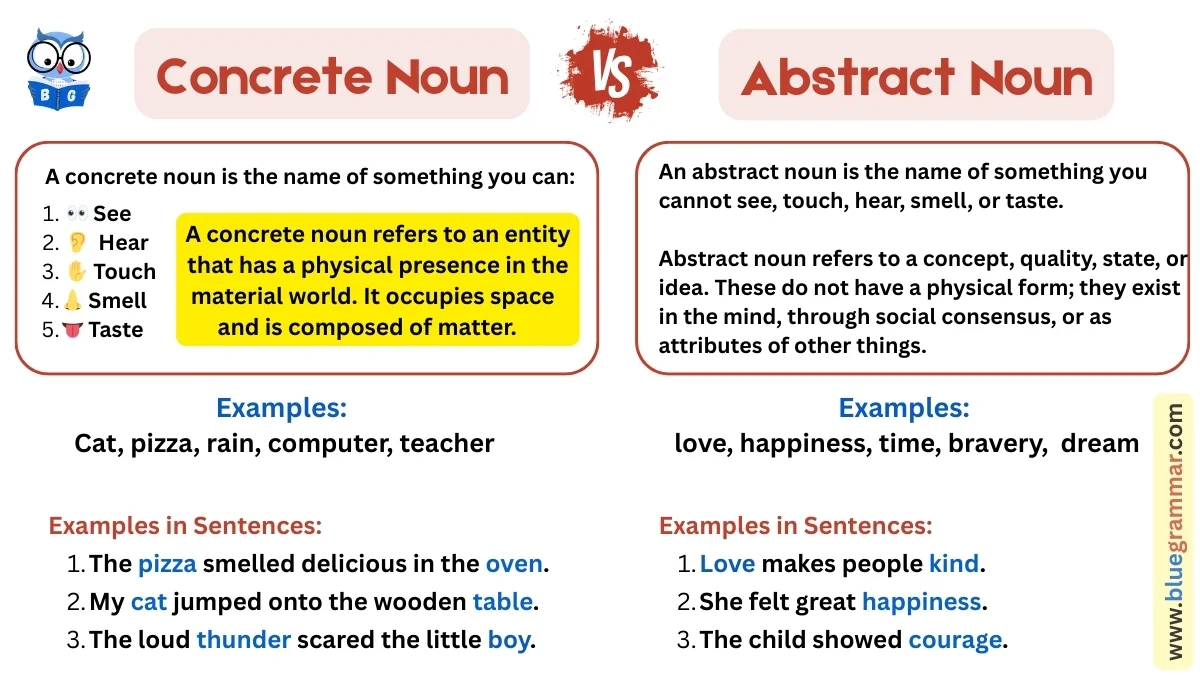
A concrete noun is the name of something you can see, hear, touch, smell, or taste. If you can experience it with your five senses, it is a concrete noun. A concrete noun refers to an entity that has a physical presence in the material world. It occupies space and is composed of matter.
Examples of Concrete Nouns
Book, chair, dog, apple, rain, music, milk, flower
Concrete Nouns in Sentences
- The dog is barking loudly.
- She ate an apple.
- The baby is playing with a toy.
- Rain is falling outside.
Note: I can hear music from the room. (Music is a concrete noun)
Even if you cannot touch it (like music), you can hear it — so it is concrete.
What Is an Abstract Noun?
An abstract noun is the name of something you cannot see, touch, hear, smell, or taste. It refers to a concept, quality, state, emotion, process, or idea that cannot be perceived through the five senses.
Examples of Abstract Nouns
Love, happiness, anger, freedom, honesty, fear, kindness, friendship
Abstract Nouns in Sentences
- Love makes people kind.
- She felt great happiness.
- Honesty is important.
- The child showed courage.
- Friendship makes life better.
You cannot touch love or see honesty — they are ideas or feelings.
You can sense a concrete noun but you cannot sense an abstract noun. Concrete noun is a physical entity but abstract noun is an idea or feeling.
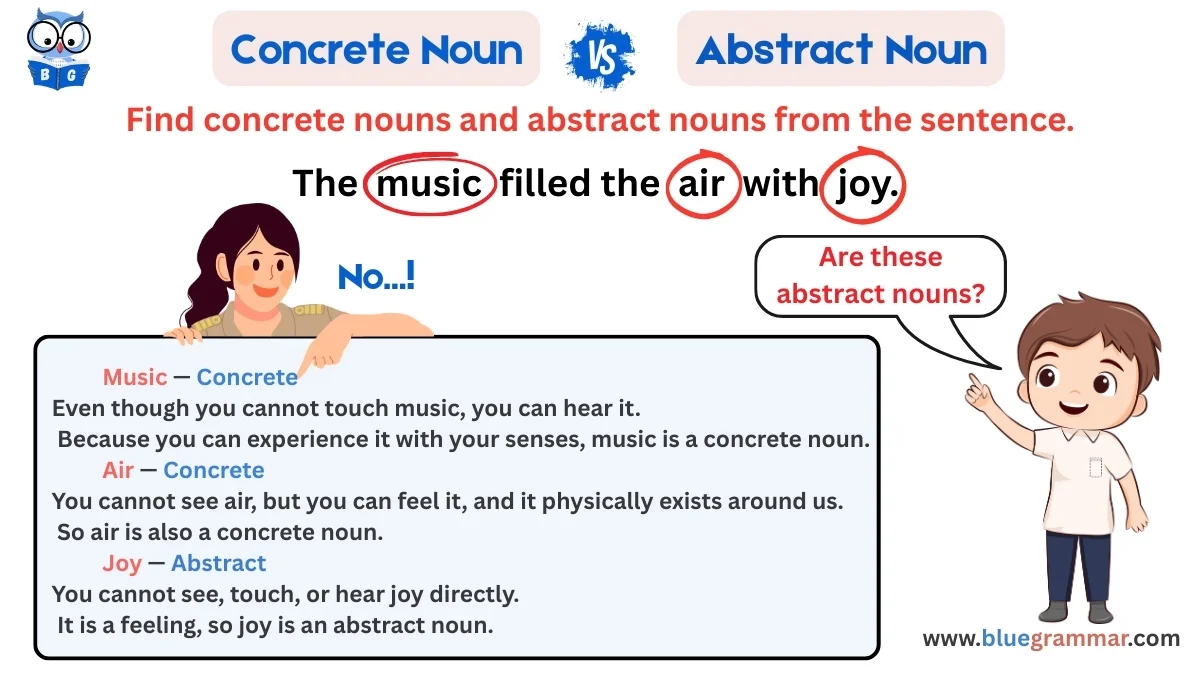
Example: The music filled the air with joy.
In the above example, there are three confusing words. Let us explain them one by one:
- Music — Concrete Noun: Even though you cannot touch music, you can hear it. Because you can experience it with your senses, music is a concrete noun.
- Air — Concrete Noun: You cannot see air, but you can feel it, and it physically exists around us. So air is also a concrete noun.
- Joy — Abstract Noun: You cannot see, touch, or hear joy directly. It is a feeling, so joy is an abstract noun.
Some Other Tricky Words
Some words can be both, depending on meaning.
Example:
- The light is bright. (Concrete – you can see it.)
- She saw the light. (Abstract – it means understanding.)
Common Misunderstandings in Concrete vs Abstract Nouns
1. The “Invisible” Fallacy
Many students think if you can’t see it, it’s abstract.
Correction: Air, wind, and oxygen are concrete. Even though they are invisible to the naked eye, we can feel them as they are composed of physical molecules (matter). They can be weighed and measured in a lab.
2. Gerunds (Verbal Nouns)
Words ending in -ing often function as abstract nouns.
Example: “Running is my therapy.”
Here, running is an abstract concept of an activity. You can see a person run (the action), but you cannot “hold” the concept of running in your hand.
3. Attributes vs. Entities
Advanced writers often confuse an adjective with an abstract noun.
- Adjective: “He is brave.” (Describes a person)
- Abstract Noun: “His bravery was noted.” (Refers to the quality itself)
Summary
In conclusion, concrete nouns and abstract nouns represent two different ways of naming things in English. A concrete noun refers to something that can be seen, touched, heard, smelled, or tasted, such as apple, dog, or music. In contrast, an abstract noun refers to ideas, qualities, or feelings that cannot be experienced through the senses, such as love, honesty, or freedom. Understanding the difference between these two types of nouns helps learners describe both the physical world and human emotions or concepts more clearly in their writing and speech.