
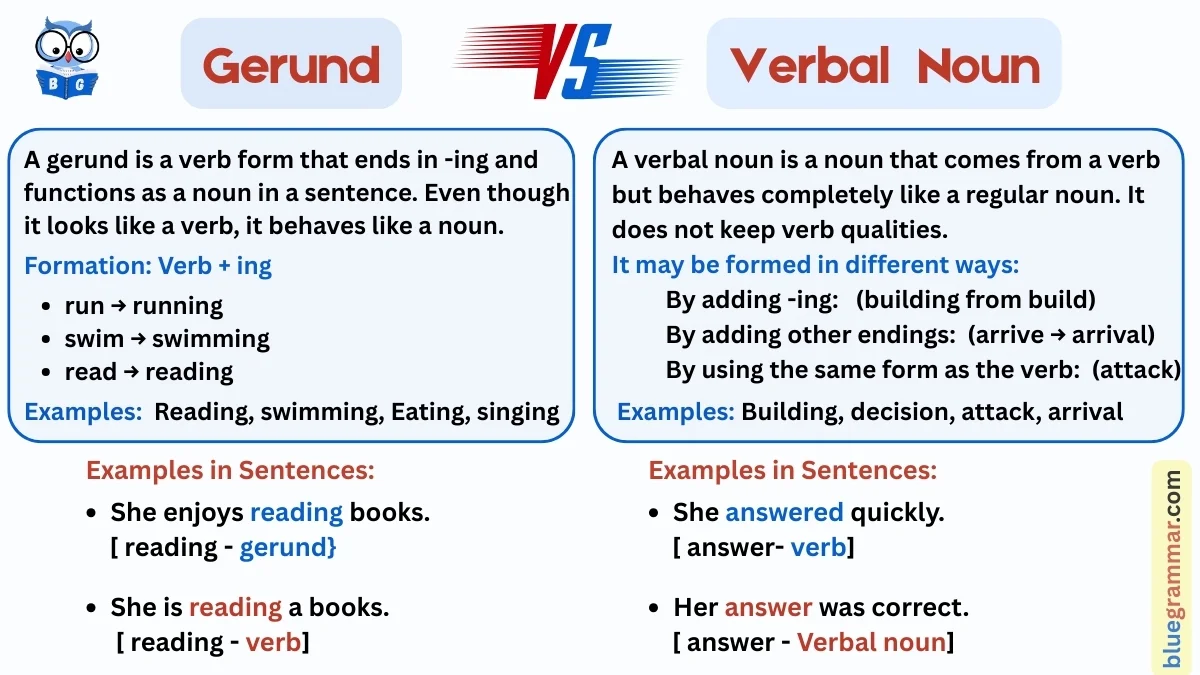
Many students often confuse gerunds and verbal nouns because both are formed from verbs and can look very similar, often ending in –ing. However, they behave quite differently in sentences. A gerund keeps some verb-like qualities: it can take direct objects and be modified by adverbs, as in “Writing essays quickly helps improve grades” (essays is the direct object, quickly is an adverb). A verbal noun, in contrast, acts completely as a regular noun: it cannot take objects or adverbs and instead uses prepositions or adjectives for modification, as in “The quick completion of the essays impressed the teacher” (quick is an adjective modifying the verbal noun, and of the essays shows possession). Recognizing this difference helps in constructing sentences correctly and in understanding how actions can be expressed either as verbs or as nouns.
What Is a Gerund?
A gerund is the -ing form of a verb that acts as a noun in a sentence while retaining certain verb characteristics, such as taking objects or being modified by adverbs. For example, in “Swimming improves health,” swimming functions as the subject of the sentence, which is a noun role, but it still represents the action of swimming, reflecting its verbal nature. Gerunds can appear in various noun positions—subjects, objects, or complements—allowing actions or activities to be treated as things, which makes them versatile and essential in English grammar.
Formation of a Gerund
Verb + -ing: run → running, write → writing
How Gerunds Work in Sentences
A gerund can function in different roles in a sentence while still representing an action.
- As a subject: The gerund starts the sentence and shows what the sentence is about.
- “Reading improves vocabulary”
- “Swimming is good exercise”
- As an object of a verb: The gerund receives the action of another verb.
- “She enjoys painting”
- “They avoid driving at night”
- As an object of a preposition: Appears after a preposition to complete its meaning.
- “He is good at drawing”
- “She left without saying goodbye”
Important Feature of Gerunds
Gerunds can perform some of the functions of verbs even while acting as nouns. They can take direct objects, just like a regular verb; for example, in the sentence “I enjoy reading books,” the gerund reading has the direct object books. Gerunds can also be modified by adverbs, showing how the action is performed, as in “She carefully avoided making mistakes,” where carefully describes the manner of making. These features allow gerunds to retain their verbal qualities, making them flexible tools in English for expressing actions as nouns.
Examples:
- She enjoys reading books. (“books” is the object of reading)
- He likes running quickly. (“quickly” is an adverb modifying running)
This shows that a gerund still behaves partly like a verb.
What Is a Verbal Noun?
A verbal noun is a noun that is formed from a verb but functions entirely as a regular noun in a sentence. Unlike a gerund, it does not retain any verb qualities—it cannot take direct objects or be modified by adverbs. For example, in “His arrival was late,” the word arrival comes from the verb arrive, but it acts purely as a noun. Similarly, in “The building of the bridge took months,” building is derived from build, yet it behaves completely as a noun, showing that verbal nouns allow actions or processes to be referred to as things without keeping the characteristics of a verb.
How Verbal Nouns Are Formed
Verbal nouns can be formed in different ways:
1. By adding –ing
building, painting, singing
2. By adding suffixes
- -tion → decision, destruction
- -ment → movement, development
- -al → arrival, refusal
- -ance → performance
Examples:
- The decision was difficult.
- The arrival of the train was late.
- The movement of the car was slow.
3. No change in form (same as verb)
Some words look exactly like verbs but can act as nouns: attack, call, change, answer, hope
Examples:
- Verb: They attacked the city.
- Noun: The attack on the city was unexpected.
- Verb: She answered quickly.
- Noun: Her answer was correct.
These are also verbal nouns because they come from verbs but function as nouns.
Key Differences Between Gerunds and Verbal Nouns
The difference between a gerund and a verbal noun can be seen in how they retain or lose verb qualities. In the sentence “Destroying the city caused panic,” destroying is a gerund that takes a direct object, the city, showing its verbal nature. In contrast, the verbal noun version, “The destruction of the city caused panic,” uses of the city instead, because verbal nouns do not take direct objects. Similarly, in “She likes dancing gracefully,” the gerund dancing is modified by the adverb gracefully, keeping its verb-like quality. When expressed as a verbal noun—“Her graceful dancing impressed everyone”—the action is described by the adjective graceful rather than an adverb, illustrating that verbal nouns behave fully like nouns and lose the ability to take objects or adverbial modifiers.
Common Confusions
Confusion 1: All -ing words are gerunds
- Running is fun. (Here running is a gerund)
- The running of the race was delayed. (Here running is a verbal noun)
Confusion 2: Only -ing words are verbal nouns
Words like attack, arrival, decision, movement are also verbal nouns.
Examples:
- The attack on the city shocked everyone.
- The arrival of the guests was late.
Confusion 3: Gerund and Present Participle are the same
They look alike but are different.
- She is running. (Present participle – verb tense)
- Running is healthy. (Gerund – noun)
Important Notes
- Every gerund is an -ing form.
- Not every -ing noun is a gerund.
- Verbal nouns may end in -ing, -tion, -ment, -al, or have no change in form.
- The difference depends on behavior, not just spelling.
- Gerunds are more common in everyday English.
Final Summary
Both gerunds and verbal nouns come from verbs. A gerund still behaves partly like a verb. A verbal noun behaves completely like a noun. Verbal nouns are not limited to -ing forms; words like attack, arrival, decision, movement are also verbal nouns. Understanding this difference improves accuracy in your academic and formal writing.