
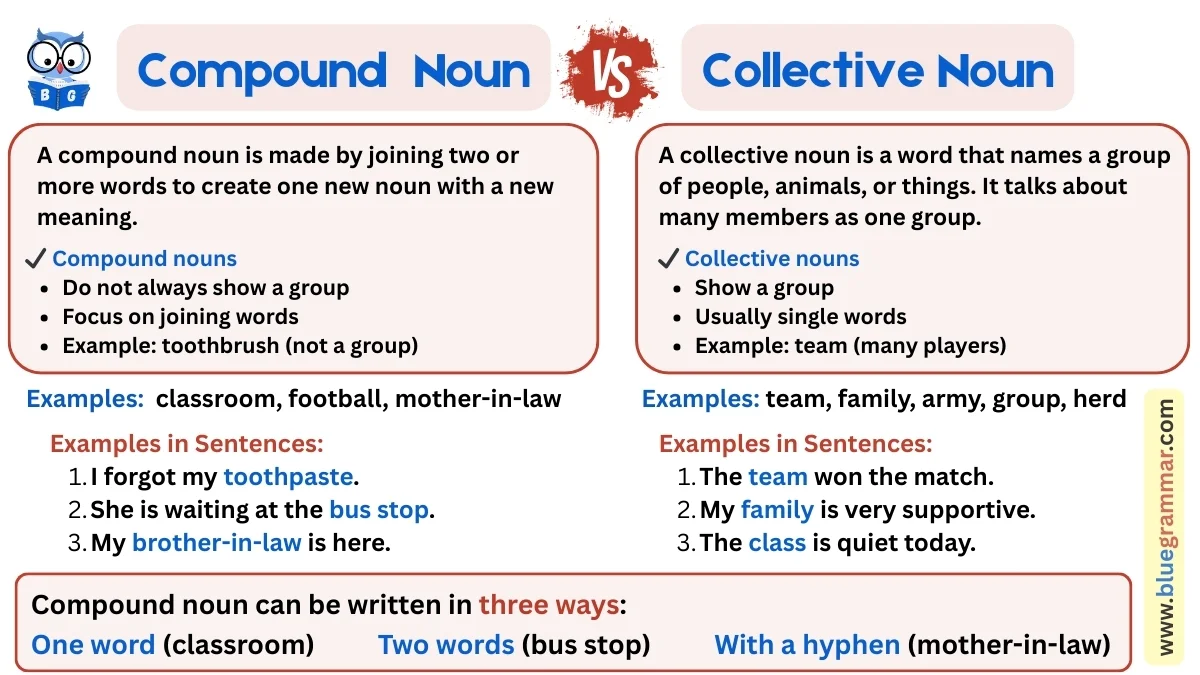
Many students get confused between compound nouns and collective nouns because both talk about more than one idea. But they are different. Sometimes we put two words together to make a new one, and sometimes one word represents a whole group of people. Here is a simple guide to understand compound nouns and collective nouns without the confusing jargon.
Let’s understand them in a simple way.
What Is a Compound Noun?
A compound noun is made by joining two or more words to create one new noun with a new meaning. They are commonly formed from combinations like noun + noun, adjective + noun, or verb + noun, and they are widely used in everyday English to name people, places, things, or ideas more precisely.
It can be written in three ways:
-
One word (Closed form)
- toothpaste
- classroom
- football
-
Two words (Open form)
- bus stop
- post office
- living room
-
With a hyphen (Hyphenated form)
- mother-in-law
- well-being
- check-in
Examples in Sentences
- I forgot my toothpaste.
- She is waiting at the bus stop.
- My classroom is very clean.
- We visited the post office.
In all these examples, two words join together to make one noun.
What Is a Collective Noun?
A collective noun is a single word that refers to a group of people, animals, or things considered as one unit. Although the word appears singular in form, it represents multiple members acting together as a group. Collective nouns help us talk about many individuals collectively rather than naming each one separately. For example, words like team, family, class, and herd describe groups made up of several members but are treated as one entity in a sentence. Depending on the context and the variety of English used, a collective noun may sometimes take either a singular verb (when the group acts as one unit) or a plural verb (when the focus is on the individual members).
Examples of Collective Nouns
team, family, class, army, group, bunch, herd, flock
Examples in Sentences
- The team won the match.
- My family is very supportive.
- A herd of cows crossed the road.
- The class is quiet today.
Even though many people or animals are included, we use one word to name the whole group.
Are Collective Nouns Singular or Plural?
This topic often causes confusion for ESL (English as a Second Language) learners because the correct verb form can change depending on the variety of English being used. In particular, American English and British English treat collective nouns slightly differently.
In American English (US), collective nouns are usually treated as singular because the group is considered one unit. Therefore, they take a singular verb.
Example: The staff is happy.
In British English (UK), collective nouns are often treated as plural when the sentence emphasizes the individual members of the group rather than the group as a single unit. In this case, they may take a plural verb.
Example: The staff are arguing among themselves.
In simple terms, American English focuses on the group as one whole, while British English sometimes focuses on the individuals within the group. Because of this difference, both forms can be correct depending on the style of English being used.
Main Differences Between Compound and Collective Nouns
- Compound nouns are made of two or more words, while collective nouns are usually formed from a single word.
- A compound noun creates a new meaning by combining words, while a collective noun names a group of people, animals, or things.
- To pluralize a compound noun, we usually add –s to the main word. In collective nouns, we add –s to show more than one group.
- Compound nouns may appear as open (spaced), closed, or hyphenated words, while collective nouns are usually single, simple words.
- Examples of compound nouns: bedroom, school bus
- Examples of collective nouns: team, family
Final Summary
In summary, a compound noun is formed by joining two or more words to create a single noun with a new meaning, while a collective noun is one word used to name a group of people, animals, or things. Although both belong to the category of nouns, they serve different purposes in English grammar. A compound noun focuses on combining words to form a new idea, whereas a collective noun focuses on describing many members as one group. Understanding this difference makes it easier for learners to recognize and use these nouns correctly in sentences.