
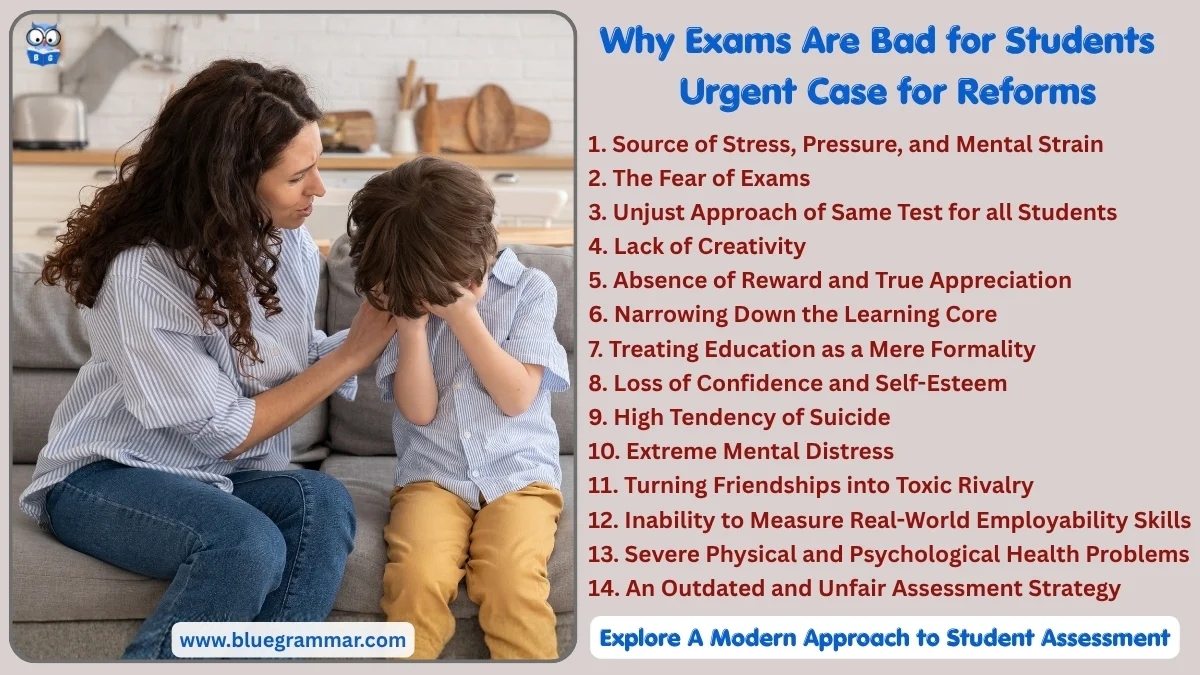
Say No to Annual Exams: Why Tests and Exams Are Bad for Students
We are living in a modern era where almost all aspects of human life have evolved dramatically. Old-fashioned norms and legacy systems are changing rapidly across technology, industry, and social institutions. However, despite these modern approaches and learning theories, many regions across the globe still rely heavily on century-old educational evaluation frameworks. We must phase out outdated strategies like high-stakes annual tests, passive dictation, and forced memorization. Instead, we need dynamic learning models that prepare children for real-world life rather than confining their worth to numerical grades on a sheet of paper.
Understanding the Traditional Examination System
In standard academic institutions, examinations are treated as the ultimate measure of student worth. Annual exams occur after twelve months, bi-annual exams every six months, and semester systems break the academic year into two intensive assessment windows. While assessments are intended to measure progress, high-stakes final tests often create an atmosphere of anxiety and hyper-competition. The final month of any academic term is routinely sacrificed to exam preparation, leaving students exhausted, sleepless, and overwhelmed by the fear of looming results.
1. Source of Stress, Pressure, and Mental Strain
Exams are a primary catalyst for chronic stress among young learners. The sudden influx of pressure during assessment weeks leads to mental fatigue, burnout, and a deep-seated hatred for academic environments. When students view learning through the lens of anxiety, their intrinsic interest in discovering new concepts vanishes. This persistent fear of failure disrupts memory retention, impairs cognitive function, and manifests in physical symptoms like tension headaches, nausea, and emotional numbness.
2. The Fear of Exams
The paralyzing fear of exams—often termed test anxiety—goes far beyond ordinary nervousness. Long before the test paper arrives, students experience intense psychological dread triggered by high expectations from parents, teachers, and peers. This overwhelming fear places the brain in a state of fight-or-flight, severely hindering a student's ability to recall information they actually know. Consequently, brilliant thinkers frequently perform poorly simply because the high-stakes environment terrifies them, proving that the system measures a child's stress tolerance rather than their true understanding.
3. Unjust Approach of Same Test for Students with Different Abilities
One of the most fundamentally flawed aspects of the traditional exam system is its one-size-fits-all methodology. Expecting every student in a diverse classroom to demonstrate intelligence through identical written papers is profoundly unfair. A single standard test penalizes visual learners, kinesthetic builders, original artists, and empathetic communicators while favoring those who excel at fast-paced rote recall. Standardized testing ignores individual strengths and evaluates a fish by its ability to climb a tree, reducing multifaceted human talent to a single rigid metric.
4. Lack of Creativity
Traditional examination formats prioritize conformity over innovation. Because standardized tests rely on predetermined answer keys, multiple-choice questions, and strict mark schemes, they heavily penalize unconventional thinking or alternative problem-solving strategies. When students are trained solely to predict what an examiner wants to read, their innate curiosity and creative drive fade away. Divergent thinking is replaced by mechanical memorization, leaving young minds ill-equipped for real-world challenges that demand original solutions.
5. Absence of Reward and True Appreciation
The current system is designed around a winner-take-all structure where only top-ranking students receive public praise or awards. Dozens of students who demonstrate dramatic personal growth, leadership, technical talent, or emotional resilience are left unacknowledged simply because their test scores fall average. This persistent lack of recognition demotivates hardworking students, instilling a belief that their unique efforts are worthless if they do not translate into top percentile marks.
6. Narrowing Down the Learning Core
High-stakes testing inevitably leads to the damaging practice of "teaching to the test." Instead of exploring rich, open-ended concepts or engaging in practical experiments, educators are forced to compress the curriculum into exam-focused drill sessions. Subjects non-essential to test scores—such as physical education, fine arts, practical ethics, and collaborative life skills—are systematically sidelined. As a result, the core purpose of education is narrowed down from holistic personal growth to mere test preparation.
7. Treating Education as a Mere Formality
Because exams serve as gatekeepers for university entry and job placement, students increasingly view education as a transactional routine rather than a meaningful journey. Learning becomes a temporary exercise in cramming information to pass a test, only to forget it days later. Superficial knowledge is rewarded with high grades, while genuine intellectual curiosity is ignored. When passing a test becomes the sole goal, true scholarship dies.
8. Loss of Confidence and Self-Esteem
Building resilience and confidence should be central to early education, yet traditional exams regularly erode self-esteem. A single bad test score—often caused by temporary illness or personal hardship—can label a student as "weak" or "unintelligent." Subjected to societal criticism and harsh peer comparison, students internalize these artificial labels, losing faith in their capabilities and dropping out of intellectual pursuits altogether.
9. Alarmingly High Tendency of Suicide and Extreme Mental Distress
The immense pressures of the examination cycle carry grave human costs. In many regions, academic results coincide with spikes in self-harm and youth suicide. When a child's entire future is conditioned upon a single set of exam papers, the threat of failure feels life-shattering. Educational systems that drive young people to despair in pursuit of numerical percentages require immediate and compassionate reform.
10. Turning Friendships into Toxic Rivalry
Standardized testing fosters hyper-competitive classroom environments where peers are viewed as rivals rather than collaborators. Students become reluctant to share notes, help struggling classmates, or engage in genuine teamwork out of fear of losing their competitive edge. This artificial rivalry undermines social harmony and prevents students from developing essential interpersonal skills like empathy, cooperation, and collective problem-solving.
11. Inability to Measure Real-World Employability Skills
A written exam cannot evaluate critical life skills such as emotional intelligence, adaptive communication, project planning, public speaking, or cross-functional leadership. Modern workplaces demand adaptable, creative problem-solvers who thrive in dynamic team environments. By relying on paper-and-pencil tests, educational institutions graduate students with high GPA marks who nevertheless struggle with practical, real-world execution.
12. Severe Physical and Psychological Health Problems
The study habits enforced by last-minute exam prep wreak havoc on student health. Extreme sleep deprivation, poor nutrition, excessive caffeine reliance, and sedentary isolation lead to weakened immune systems, digestive distress, and severe fatigue. In high-pressure university settings, some students even resort to prescription stimulants or substance abuse to survive exam marathons, severely compromising their long-term health.
13. An Outdated and Unfair Assessment Strategy
Ultimately, high-stakes terminal examinations are an unfair and outdated method for assessing human potential. Expecting a student to demonstrate twelve months of learning in a concentrated two-hour sitting ignores human variables like acute illness, family emergencies, or unexpected panic attacks. A modern society cannot continue to rely on a rigid century-old framework to measure the complex, evolving intellect of modern learners.
Moving Forward: A Modern Approach to Student Assessment
Abolishing exams overnight without an alternative is not the goal; rather, we must end our reliance on high-stakes final tests as the sole arbiter of student capability. Educational institutions must shift toward continuous, multifaceted evaluation models that incorporate portfolio reviews, practical lab projects, peer discussions, continuous coursework, and self-directed research.
By combining diversified assessment methods with personalized learning paths, we can create an educational ecosystem that celebrates different forms of intelligence. Assessment should empower and inspire learners—nurturing their creativity, building their confidence, and preparing them for meaningful, balanced lives in the real world.