
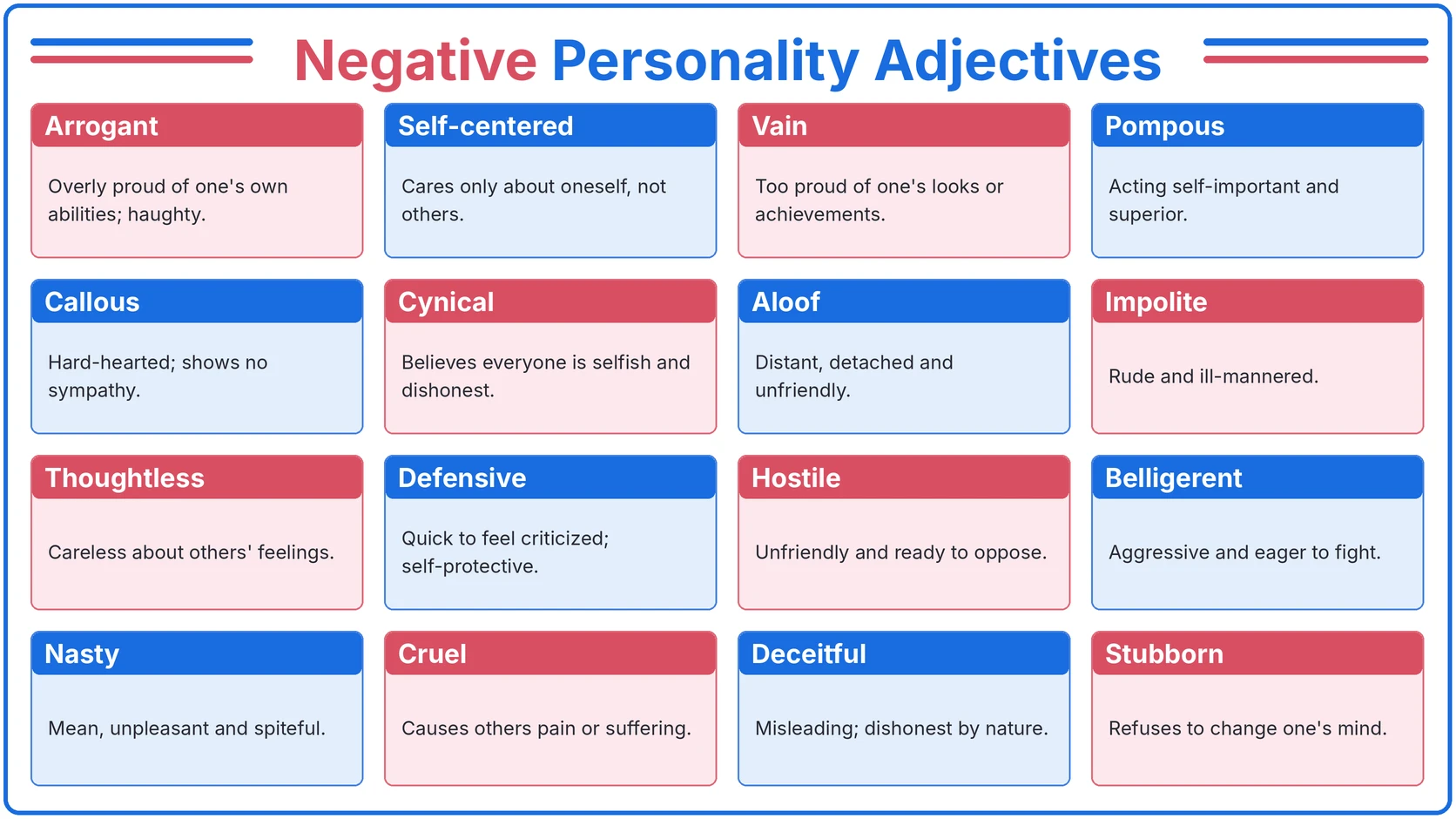
What Are Negative Personality Adjectives?
Negative personality adjectives are descriptive words used to identify toxic, harmful, unhelpful, or unpleasant character traits. These words cover a wide spectrum of human behavior—ranging from mild habits like being disorganized or indecisive, to severe behavioral flaws like hostility, deceitfulness, or cruelty.
30+ Essential Negative Personality Adjectives
Below is a comprehensive, structured guide to over 30 negative personality adjectives. Each entry includes a clear definition, an elaboration explaining how the trait manifests in real-world behavior, and a realistic example sentence.
1. Aloof
Definition: Unfriendly, distant, or detached in manner.
Elaboration: Aloof individuals intentionally or unintentionally distance themselves from others. They rarely share their feelings, avoid casual social banter, and often appear uninterested in forming meaningful interpersonal connections.
Example: He preferred to keep himself aloof from office politics and social gatherings.
2. Arrogant
Definition: Showing an exaggerated sense of one's own importance or abilities.
Elaboration: Arrogant people believe they are superior to those around them. They frequently dismiss the opinions of others, brag about their accomplishments, and look down on those they consider less capable.
Example: Even though Ali achieved first position in his college, he remained humble and was not arrogant about his success.
3. Belligerent
Definition: Hostile, aggressive, and eager to fight or argue.
Elaboration: A belligerent person reacts to minor disagreements with intense confrontation. They constantly look for conflict, refuse peaceful resolution, and create tense environments wherever they go.
Example: The belligerent customer began shouting at the store clerk over a minor misunderstanding.
4. Callous
Definition: Hard-hearted, insensitive, and showing no sympathy or concern for others.
Elaboration: Callous individuals remain indifferent to the suffering or emotional pain of those around them. They lack empathy and often make cold, hurtful choices without feeling remorse.
Example: The manager's callous response to the worker's personal emergency shocked everyone in the department.
5. Careless
Definition: Not paying enough attention to avoid mistakes, harm, or damage.
Elaboration: Careless people act without thinking through consequences or checking details. Their lack of precision often leads to avoidable errors, accidents, or extra work for others.
Example: A careless mistake in the financial spreadsheet caused significant delays for the accounting team.
6. Clingy
Definition: Excessively dependent on someone else for emotional support or reassurance.
Elaboration: Clingy individuals fear abandonment or independence, leading them to demand constant attention, reassurance, and physical or emotional proximity from partners or friends.
Example: Her clingy behavior made it difficult for her friends to enjoy personal time on their own.
7. Cowardly
Definition: Lacking courage or fortitude when facing danger, difficulty, or pain.
Elaboration: Cowardly individuals abandon their principles or duties out of fear. Instead of confronting challenges or standing up for others, they retreat to safeguard themselves.
Example: Leaving his teammate behind during the crisis was considered a cowardly act.
8. Cruel
Definition: Willfully causing pain, distress, or suffering to others without feeling guilt.
Elaboration: Cruelty involves actively enjoying or disregarding the physical or emotional anguish inflicted on living beings, representing one of the most severe negative character flaws.
Example: Cruel treatment of animals should be strictly penalized by law.
9. Cynical
Definition: Believing that people are motivated purely by self-interest and dishonesty.
Elaboration: Cynical people view good deeds with suspicion, assuming everyone has a hidden, selfish motive. They struggle to trust genuine acts of kindness or optimism.
Example: Cynical individuals often doubt the sincerity of charitable donations, assuming they are done for publicity.
10. Deceitful
Definition: Guilty of or given to misleading, tricking, or lying to others.
Elaboration: Deceitful people deliberately conceal truth, manipulate facts, or act dishonestly to gain personal advantages at the expense of others.
Example: The deceitful seller hid the structural damage of the car before selling it to an unsuspecting buyer.
11. Defensive
Definition: Overly sensitive to criticism and quick to justify oneself.
Elaboration: Defensive individuals view constructive feedback or simple questions as personal attacks. Instead of listening, they instantly deflect blame, make excuses, or counterattack.
Example: Whenever his work was reviewed, his defensive attitude made it challenging to offer constructive suggestions.
12. Finicky
Definition: Fussy and overly demanding about tiny details or standards.
Elaboration: Finicky people are notoriously hard to please because they insist on specific, rigid preferences for food, clothing, or surroundings, frequently complaining over minor defects.
Example: The finicky diner sent his meal back twice because the soup wasn't served at his exact preferred temperature.
13. Gullible
Definition: Easily persuaded or tricked into believing whatever one is told.
Elaboration: Gullible people lack critical skepticism, making them vulnerable to scams, false promises, or manipulative rumors because they accept statements without verification.
Example: His gullible nature made him an easy target for online financial scams.
14. Hostile
Definition: Unfriendly, antagonistic, and openly opposing others.
Elaboration: Hostile individuals project coldness, tension, or aggression toward others, creating an atmosphere of mistrust that prevents cooperative dialogue.
Example: The atmosphere in the meeting turned hostile when the two department heads began arguing over the budget.
15. Impatient
Definition: Irritated by delays, waiting, or obstacles.
Elaboration: Impatient people struggle with self-restraint when outcomes take time. They become visibly restless, annoyed, or disruptive when forced to wait or deal with slow progress.
Example: After waiting three hours for his flight delay update, he grew increasingly impatient.
16. Impolite
Definition: Rude, ill-mannered, and lacking social respect.
Elaboration: Impolite individuals ignore common courtesy, interrupt conversations, use harsh tones, and disregard basic etiquette when interacting with others.
Example: It is impolite to talk loudly on your phone while sitting in a quiet library.
17. Indecisive
Definition: Unable or hesitant to make clear choices quickly.
Elaboration: Indecisive people second-guess themselves, overanalyze options, and stall decisions, often missing key opportunities due to their chronic hesitation.
Example: Her indecisive nature meant spending nearly an hour choosing between two simple meal options.
18. Irresponsible
Definition: Careless with obligations, duties, and accountability.
Elaboration: Irresponsible individuals consistently fail to honor commitments, manage time, or care for assets, leaving others to clean up their administrative or personal messes.
Example: Leaving important business documents unattended in a public area was highly irresponsible.
19. Machiavellian
Definition: Cunning, scheming, and unscrupulous in manipulating others for power.
Elaboration: A Machiavellian personality believes that the ends justify the means. They use calculated political games, deception, and strategic manipulation without moral hesitation.
Example: He used Machiavellian tactics to undermine his rivals and secure the executive promotion.
20. Moody
Definition: Subject to unpredictable and rapid changes in temperament or emotional state.
Elaboration: Moody individuals shift quickly from cheerfulness to gloom or anger without clear reasons, making it difficult for friends and colleagues to gauge how to approach them.
Example: Working with a moody manager can be challenging because you never know what mood to expect each morning.
21. Pessimistic
Definition: Tending to see the worst aspect of things or expect bad outcomes.
Elaboration: Pessimistic people routinely anticipate failure, focus heavily on drawbacks, and drain energy from group efforts by dismissing optimistic possibilities.
Example: Despite the team's strong preparation, his pessimistic outlook led him to predict project failure.
22. Pompous
Definition: Overly grand, solemn, or self-important in speech or manner.
Elaboration: Pompous individuals use exaggerated formality, complex vocabulary, or condescending behaviors to project an aura of immense authority and intellectual superiority.
Example: The pompous speaker spoke for two hours, treating the audience as if they were uneducated children.
23. Quick-tempered
Definition: Easily provoked to sudden outbursts of anger or frustration.
Elaboration: Quick-tempered people possess a short fuse. They react to minor inconveniences with explosive verbal anger before taking time to process facts calmly.
Example: Drivers should avoid reacting aggressively, as quick-tempered responses can easily escalate road incidents.
24. Secretive
Definition: Inclined to conceal feelings, plans, or actions from others.
Elaboration: Secretive individuals deliberately hide basic information, avoid open discussions, and maintain unnecessary mystery, which often breeds suspicion among peers.
Example: The executive was unusually secretive about the company's upcoming quarterly strategy.
25. Self-centered
Definition: Preoccupied exclusively with oneself and one's own affairs; selfish.
Elaboration: Self-centered people view every situation through the lens of personal benefit. They rarely show genuine interest in the needs, feelings, or well-being of others.
Example: Due to his self-centered nature, Jack struggled to maintain long-lasting friendships.
26. Stubborn
Definition: Unreasonably resolute in opinion or purpose; obstinate.
Elaboration: Stubborn people refuse to change their views, admit mistakes, or adopt better ideas, even when presented with overwhelming evidence that they are wrong.
Example: Despite clear evidence showing a faster route, he was too stubborn to adjust his driving direction.
27. Thoughtless
Definition: Lacking consideration for the feelings, needs, or comfort of others.
Elaboration: Thoughtless individuals say or do hurtful things not always out of malice, but out of a complete failure to anticipate how their actions impact those around them.
Example: Making loud noise late at night while neighbors are sleeping is a thoughtless act.
28. Touchy
Definition: Oversensitive and easily offended by minor remarks or actions.
Elaboration: Touchy individuals take neutral observations or lighthearted banter as personal insults, requiring people around them to constantly filter their speech to avoid conflict.
Example: Be careful how you word your feedback, as he is very touchy about his creative work.
29. Unreliable
Definition: Not trustworthy or dependable; consistently failing expectations.
Elaboration: Unreliable people miss deadlines, break promises, cancel plans last minute, and produce inconsistent work, making it impossible for teams to count on them.
Example: An unreliable partner can disrupt the progress of an entire collaborative project.
30. Vague
Definition: Unclear, indefinite, or imprecise in thought, speech, or expression.
Elaboration: Vague individuals communicate with ambiguous terms and lack clarity, leaving listeners confused and forced to make assumptions to understand their intent.
Example: Giving vague instructions to your team during a crisis creates unnecessary mistakes and confusion.
31. Vain
Definition: Excessively proud of one's physical appearance, status, or accomplishments.
Elaboration: Vain people spend excessive time seeking admiration, checking their reflection, or talking about their looks and status, deriving self-worth purely from external praise.
Example: Joseph is very vain about his appearance and spends hours getting ready every morning.
32. Weak-willed
Definition: Lacking strength of purpose, determination, or moral conviction.
Elaboration: Weak-willed individuals give in easily to temptation, peer pressure, or minor obstacles, struggling to stay true to their goals or stand up for their principles.
Example: A weak-willed leader often bends under political pressure rather than doing what is right.